Inside the N Seoul Tower Observatory: A Floor-by-Floor Guide
The observatory inside N Seoul Tower is a paid deck spread across several levels of the tower, with digital telescopes, a rotating restaurant above it and a free plaza below it. Here is what is on each floor, which direction each window faces, and where the paid part of Namsan actually begins.
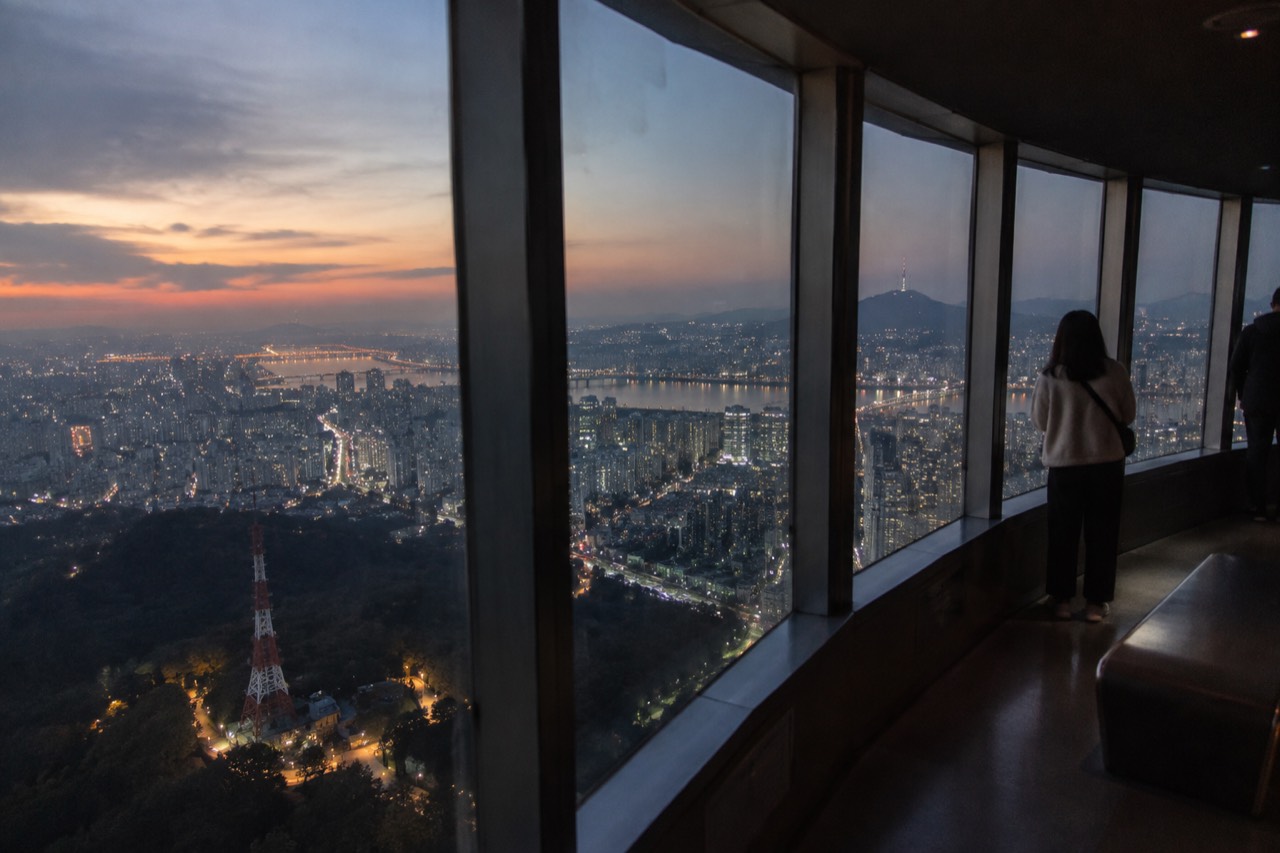
Short answer
The N Seoul Tower observatory is the ticketed observation deck inside the tower, open 10:00 to 22:30 on weekdays and 10:00 to 23:00 on weekends, with last admission 30 minutes before closing. Entry costs KRW 29,000 for adults at the gate, or from US$15.25 online. Everything around the tower base is free.
The observation deck inside N Seoul Tower is the only ticketed attraction on the whole of Namsan, and it is smaller and stranger than most first-time visitors expect. It is not one room: it is a stack of levels inside a working broadcast tower, wrapped in glass, with a rotating French restaurant above it, a Korean grill in the middle, and an Italian restaurant you can reach without buying a deck ticket at all. The mountain around it, the summit plaza, the terraces and the love locks all cost nothing.
This guide walks the tower from the plaza up: what each floor holds, which window faces which part of Seoul, what the digital telescopes do, what the ticket buys and what it does not, and how the deck fits into a day on Namsan. The observatory sits at the top of a 236.7 m tower on Namsan, reached by cable car or on foot, and an online ticket covers entry to the deck itself.
What exactly is the N Seoul Tower observatory?
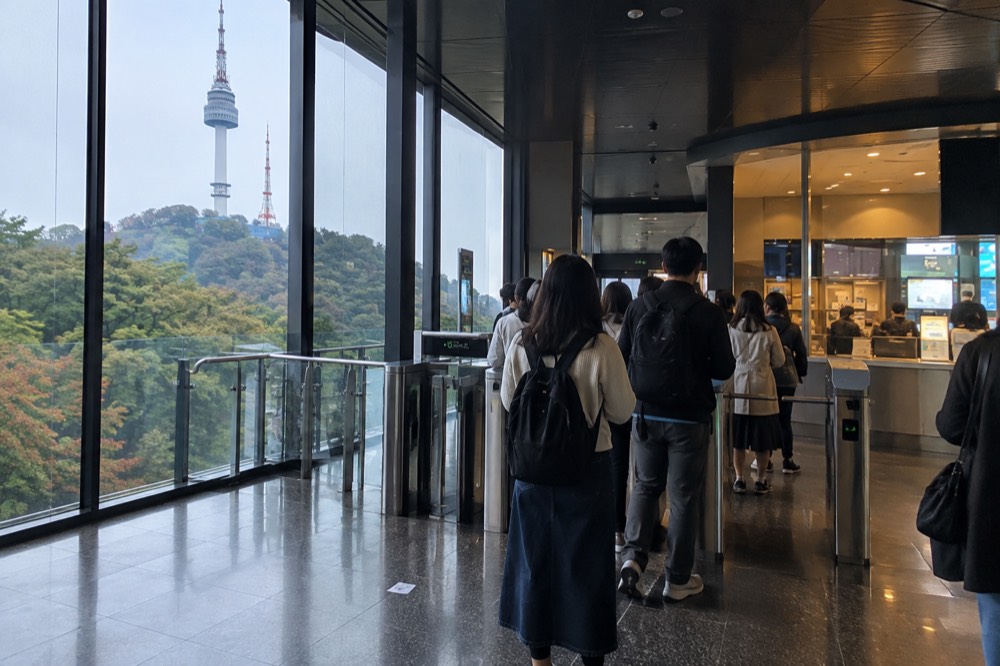
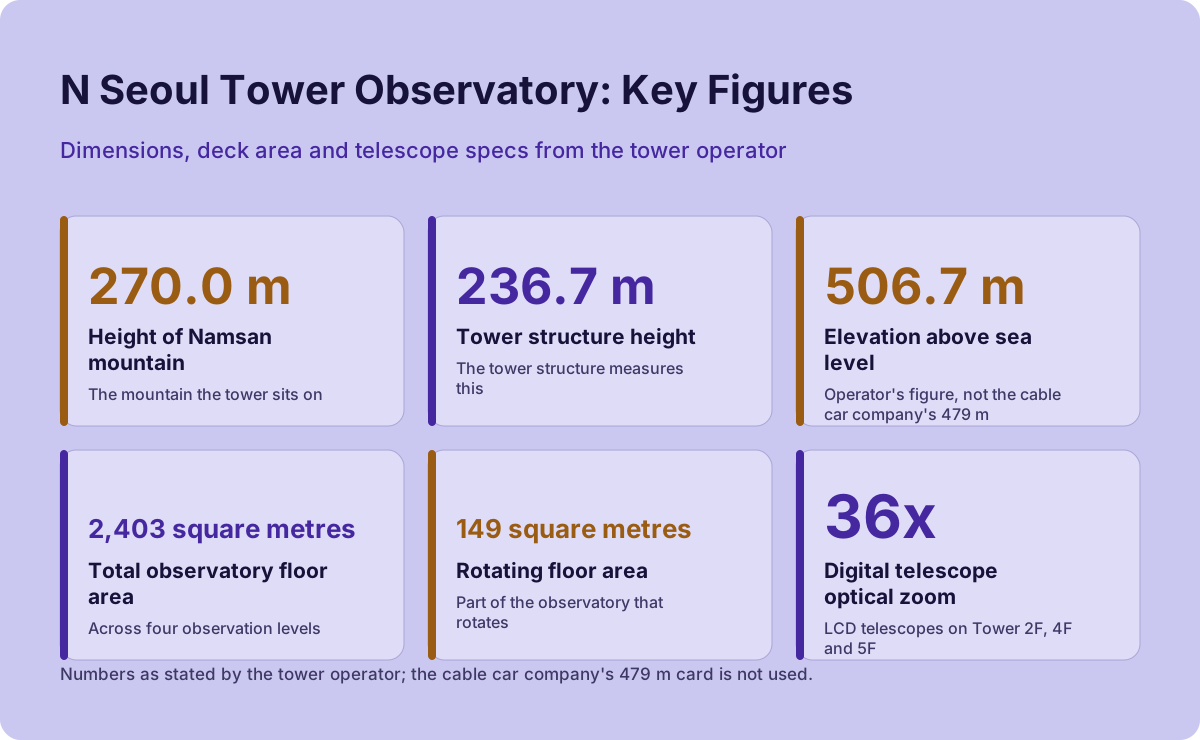
The observatory is the enclosed, glass-walled observation deck inside the upper body of N Seoul Tower, spread across several levels of the building and entered through a ticket gate at Plaza 5F or a booth at Tower 1F. It opened to the public in October 1980, sits on a mountain that is itself 270.0 m high, and the tower structure measures 236.7 m. The deck is the only thing on Namsan that requires a ticket.
The tower is a real broadcast facility first and a viewpoint second. MBC-TV began transmitting from it in April 1972, KBS-TV in August 1972 and SBS-TV in November 1991, and YTN acquired the tower in April 2000. The observatory itself was completed in July 1975 and opened to visitors in October 1980. A full renovation between April and November 2005 gave the tower its current name, "N Seoul Tower", in December of that year.
What that history means in practice is that the deck is built around a working transmitter mast. The observatory levels occupy a total floor area of 2,403 square metres across four observation levels, of which 149 square metres rotates, and the steel mast continues above the top visitor floor. The operator's own specification pages give the numbers, and the tower's total elevation above sea level is 506.7 m, made up of the 270.0 m mountain and the 236.7 m structure.
One figure to be careful with: the cable car company's homepage shows an "arrival altitude 479 m" card for the tower. That is the company's own marketing number and it does not match the tower operator's 506.7 m. Use the operator's figure, and treat the 479 m as nothing more than the cable car company's own card. The deeper story of the tower's dimensions is in how tall N Seoul Tower actually is.
What is on each floor of the tower?
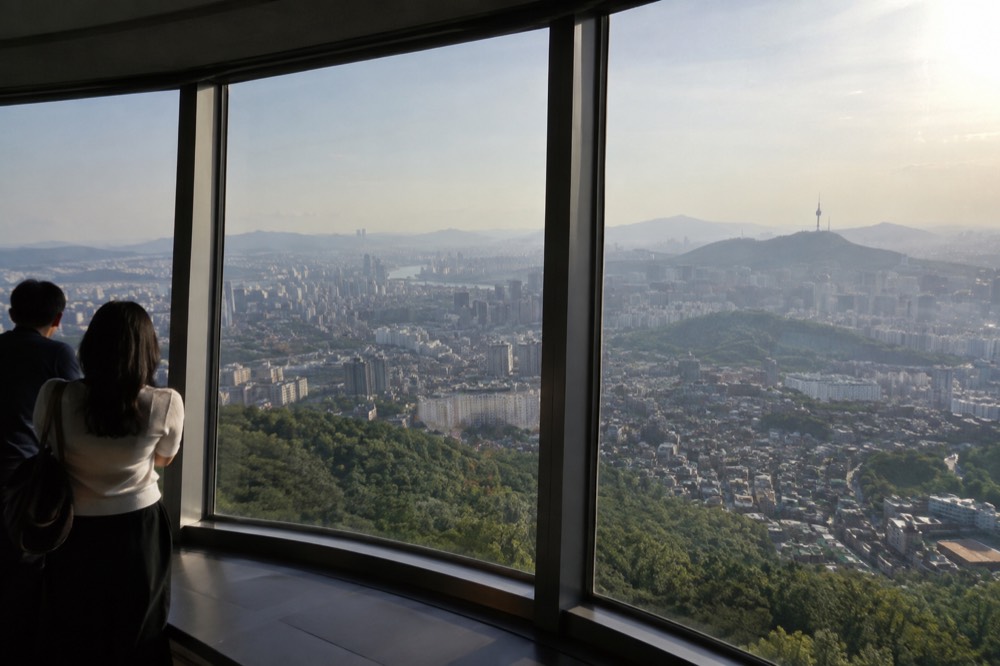
Working up from the base: Tower 1F holds the ticket booth, cafes and shops; Tower 2F holds The Place Dining and the Roof Terrace, reachable without an observatory ticket; Tower 3F holds HanCook; Tower 4F and Tower 5F are observation deck levels with cafes and digital telescopes; and Tower 7F holds n.GRILL, the rotating French restaurant. Plaza 5F, at the tower's base, holds the main observatory entrance.
The operator's floor guide is the source for all of this, and it is worth reading before you go because the tower mixes paid and free space in a way that catches visitors out. The ticket gates the deck levels, not the building. The Place Dining on Tower 2F can be used without buying an observatory ticket, which the operator's own FAQ states plainly, and the Roof Terrace sits on the same floor.
| Level | What is there | Ticket needed? |
|---|---|---|
| Plaza 5F | Observatory entrance, information desk, ticket machine, N Sweetbar, N Gift, A Twosome Place, restrooms | No, to stand here |
| Tower 1F | Ticket booth, N Terrace, N Burger, A Twosome Place, Durumi Bunsik, 7-Eleven, WiggleWiggle, N Gift, POCA i | No |
| Tower 2F | The Place Dining, Roof Terrace, digital telescope | No |
| Tower 3F | HanCook, Korean grill and dine | Restaurant reservation or ticket for the deck above |
| Tower 4F | Observation deck, A Twosome Place, Sky Restroom, digital telescope | Yes |
| Tower 5F | Observation deck, N Gift, WeenyBeeny, N Photo, digital telescope, n.GRILL check-in | Yes |
| Tower 7F | n.GRILL, rotating French restaurant | Restaurant reservation |
Two things in that table deserve emphasis. The Sky Restroom on Tower 4F is a real, named facility: a restroom with a view, and it is one of the small details people remember. And n.GRILL reservation holders check in at the Tower 5F observatory ticket booth and information desk, because an advance n.GRILL reservation includes free observatory admission. Dining at HanCook gets a discount on observatory admission rather than free entry.
The Seoul Tower Plaza below the tower, run by the building's owner rather than the deck operator, adds another two open retail floors: Starbucks, GS25, Mom's Touch, bhc Chicken, Gong Cha, tteokbokki and buckwheat noodle counters among them. None of it needs a ticket. The full eating picture, including what reopened after the March 2026 refurbishment, is covered in the restaurants inside and around N Seoul Tower.
Which window faces which part of Seoul?
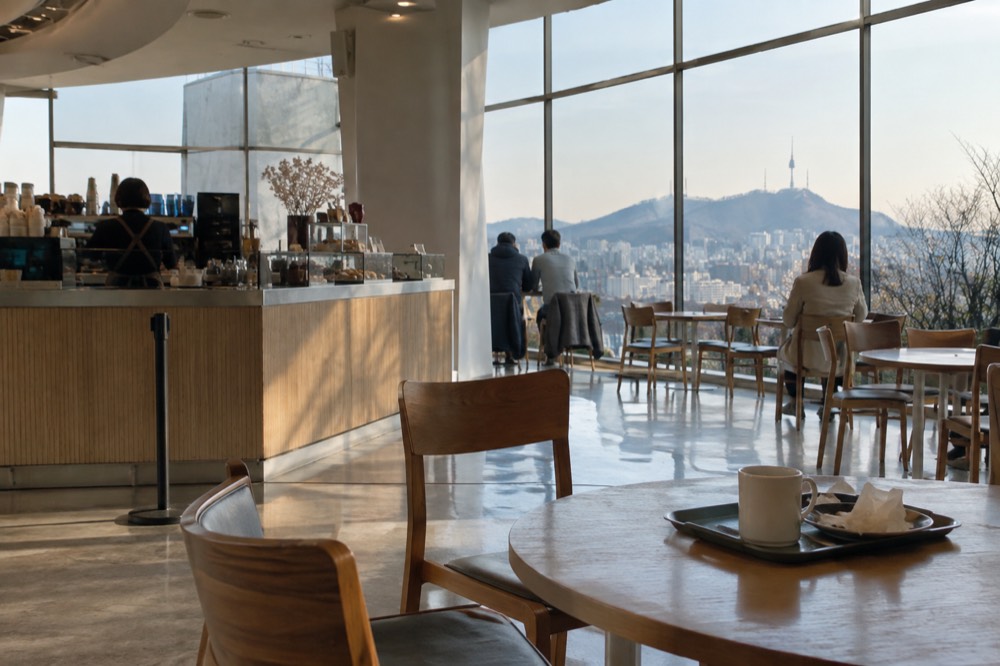
On a clear day the operator states you can see up to 50 km: Achasan and Ttukseom to the east, Yanghwa Bridge, Nanjido and Ilsan to the west, Gwanaksan and the Seoul Arts Center to the south, and Bukhansan and Cheonggyecheon to the north. Because the deck wraps the tower, every side of the observation levels gives you a different slice of the city.
The east windows look toward the Han River's middle reaches and the eastern districts. The west windows take in the river bridges and the road out toward Ilsan. The south side faces Gwanaksan, the mountain that anchors Seoul's southern skyline, and the north side looks over the city centre toward Bukhansan, with Cheonggyecheon's green corridor visible in the foreground on clear days.
The honest caveat is visibility itself. Seoul's air quality varies a lot, and the tower's own exterior lighting has signalled the city's fine-dust level since January 2011, which tells you how central dust is to daily life here. The lighting colour code behind that signalling is not published in a verified form, so this guide will not repeat one, but the fact that the tower's illumination doubles as an air-quality indicator is real and is the operator's own history.
For photographers planning shots from the deck, the windows, the glass and the light are covered in detail in the best photo spots at N Seoul Tower.
What do the digital telescopes do?
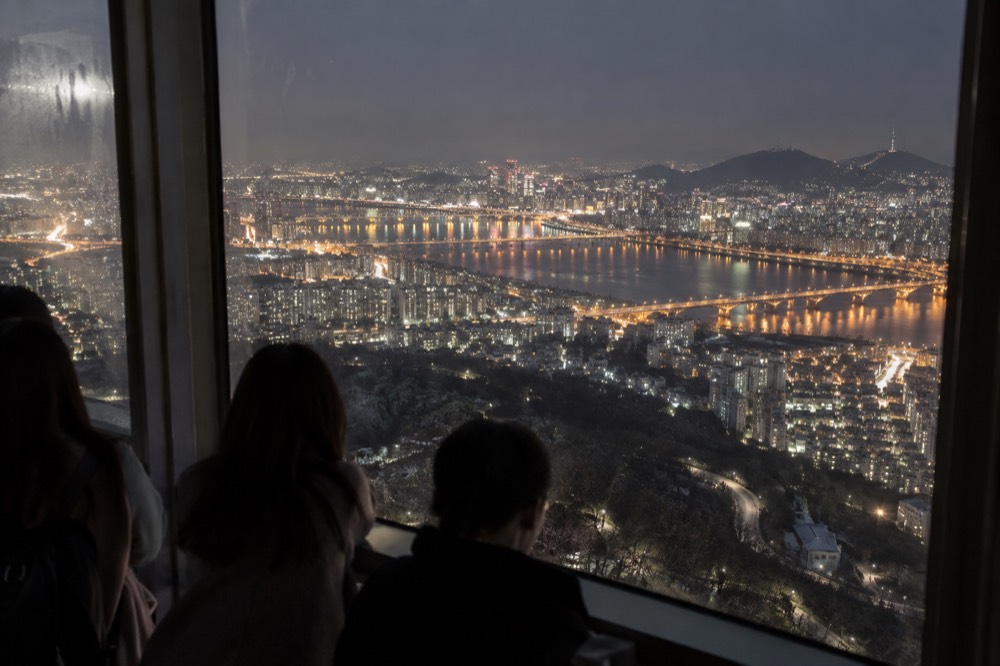
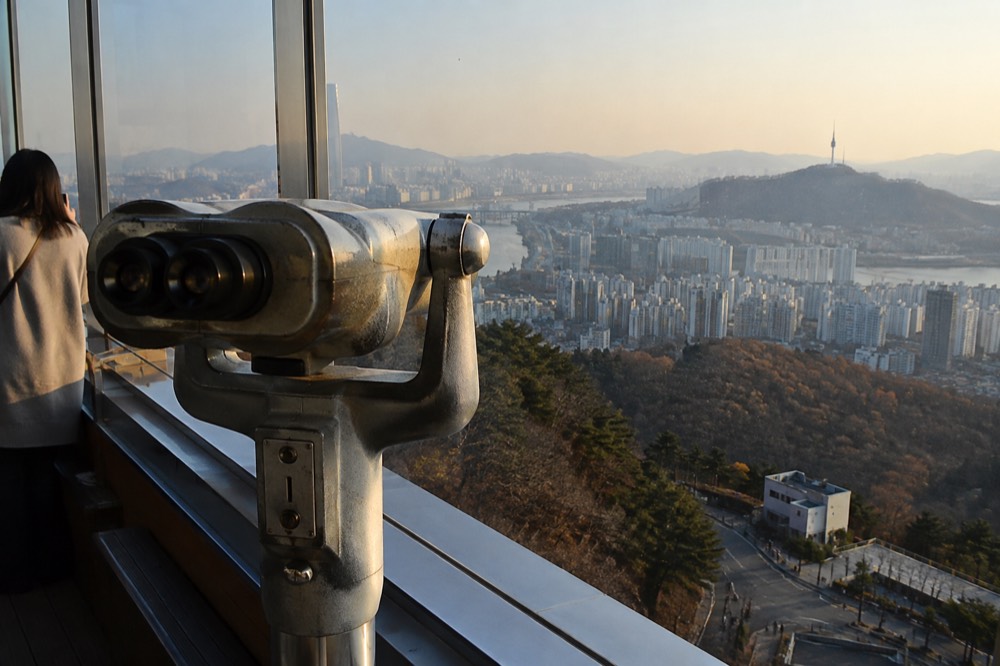
The deck carries LCD digital telescopes with optical zoom up to 36x, installed on the Tower 2F roof terrace, Tower 4F and Tower 5F. Unlike a conventional coin-operated telescope, they display the view on a screen, which lets them overlay and zoom the city rather than just magnify it.
The 36x zoom figure comes from the operator's observatory page, and it is the one hard specification published about them. What that magnification means practically is that landmarks which read as a grey mass to the naked eye, the river bridges, the far mountains, the dense roofscape of the old centre, resolve into identifiable structures. Visitors report the telescopes as one of the deck's better small pleasures, particularly on days when the horizon is hazy but the middle distance is sharp.
The telescopes sit on all three of the main viewing levels, so you are not stuck queueing for one machine. The Tower 2F roof terrace unit has the advantage of being outdoors and reachable without a deck ticket at all, which makes it the free-to-reach option in the set, though the operator's FAQ notes the terrace is subject to its own conditions.
How much does the observatory ticket cost?
At the gate, the operator's fee page lists KRW 29,000 for adults aged 13 and over, KRW 23,000 for children aged 3 to 12, and KRW 23,000 for seniors aged 65 and over, with under-36-months free, limited to one child per accompanying adult. Online, the observatory ticket starts from US$15.25 per adult. Tickets are valid on the day of purchase only.
The two prices are stated separately because they are two different things: the operator's own gate price in won, and the online listing's price in dollars. Seoul's tourism portal still shows an older, lower admission figure, which is why this guide uses only the operator's current fee page as its source. The full index of guides sits on Namsan Tower Seoul.
Discounts exist at the gate. Welfare-card disability grades 1 to 3 get 30% off for the holder plus one companion; grades 4 to 6 get 30% off for the holder only. A Seoul City Tour Bus guidebook coupon gives 10% off. Restaurant routes also change the arithmetic: an advance n.GRILL reservation includes free observatory admission, and dining at HanCook earns a discount on the deck.
| Ticket type | Gate price (operator's fee page) |
|---|---|
| Adult, 13 and over | KRW 29,000 |
| Child, 3 to 12 | KRW 23,000 |
| Senior, 65 and over | KRW 23,000 |
| Under 36 months | Free, one child per adult |
The online listing, rated 4.6 across 34,365 reviews, sells the same deck entry in several bundled forms, and the differences between them matter more than the headline price. The plain observatory ticket is the from-price option at US$15.25. A version bundling the Namsan cable car is US$28.05, and it requires collecting a physical ticket at a partner shop in Myeongdong first, with collection closing at 18:00. A fast-track version is US$40.85, and the honest description of it is that it skips the ticket counter, nothing more: one buyer reported no visible fast-track lane, and riders still queue for the cable car itself. A cocktail pairing option rounds out the set; its price is on the listing.
What are the opening hours, and when should you go?
The observatory is open 365 days a year, 10:00 to 22:30 on weekdays and 10:00 to 23:00 on weekends and public holidays, with last admission 30 minutes before closing. The operator states hours can change with weather and with Namsan vehicle-access restrictions. Evenings and weekends are the busy windows; weekday mornings and the late edge of the day are the quiet ones.
The hours come from the operator's own pages, in Korean and English, which agree exactly, and the Seoul Metropolitan Government repeats them independently. The last-admission rule, 30 minutes before closing, is the one hard clock fact to plan around, because it is the operator's published cutoff and the only form of urgency on this mountain that is actually verified.
Crowding is best described in words, because no official source states a wait in clock terms. The cable car company's own tips say mornings are quieter than afternoons and that boarding waits can get long at weekends. Visitor reports through mid-2026 agree: weekends, public holidays and evenings are the busy windows at both the tower and the cable car, while weekday visits and the early or late ends of the day are the calm ones.
One genuinely new factor for evenings: from September 2026, Seoul runs a free guided night walk over the summit itself, with departures at 18:00 and 20:00, passing the tower and the love locks and ending at Palgakjeong. The summit now has a scheduled group arriving after dark that did not exist a year ago, which adds to the evening atmosphere without costing anything. The fuller evening picture, including the tower's lighting, is in N Seoul Tower at night.
What about the rotating restaurant and the Sky Post Office?
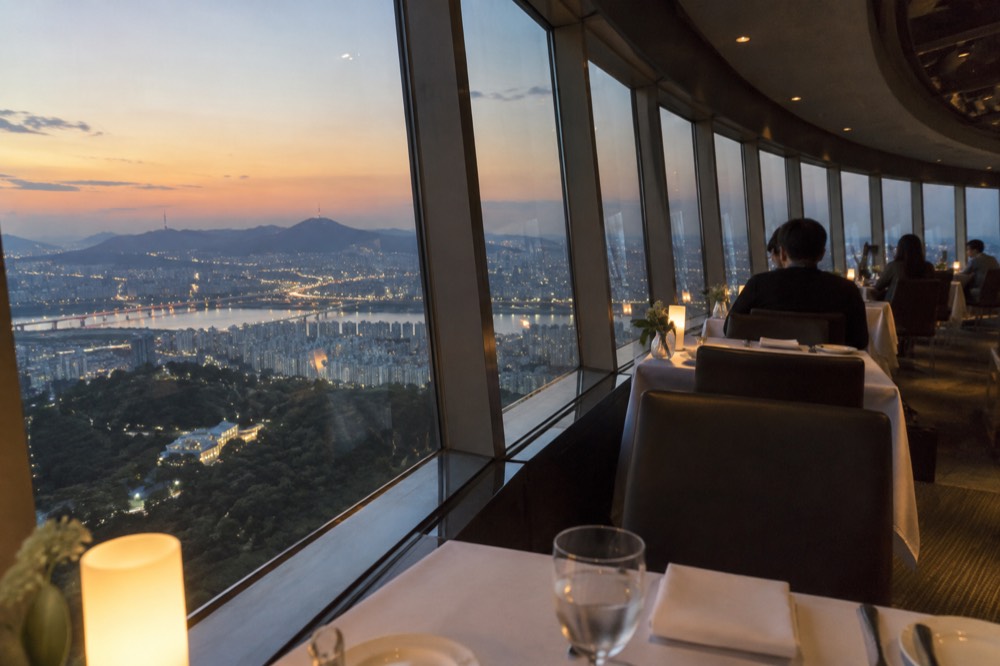
n.GRILL on Tower 7F is the operator's flagship French restaurant, and one full rotation of the dining room takes 1 hour 40 minutes. The Sky Post Office, run from the observatory's Tower Gift shop, sells postcards and stamps, with domestic delivery in 2 to 3 days and overseas in about 15 days, both stated by the operator.
The rotation speed is worth pausing on, because it is slower than most people imagine. A full turn takes an hour and forty minutes, which means a typical dinner sees the room travel only part of the way around Seoul. The observatory floors below include 149 square metres of rotating space in total, so the movement is a feature of the building, not just the restaurant.
The post office is the deck's quiet novelty. Buying a postcard at the top of a broadcast tower and posting it from there is a small ritual, and the operator's delivery estimates make it practical: a card posted to a Seoul hotel address can plausibly arrive before a foreign visitor flies home, while an overseas card takes about two weeks. Reservations for n.GRILL run through 02-3455-9297 / 9298, and remember that a reservation includes free observatory admission, which changes the ticket arithmetic for anyone planning a full evening.
How do you get to the observatory entrance?
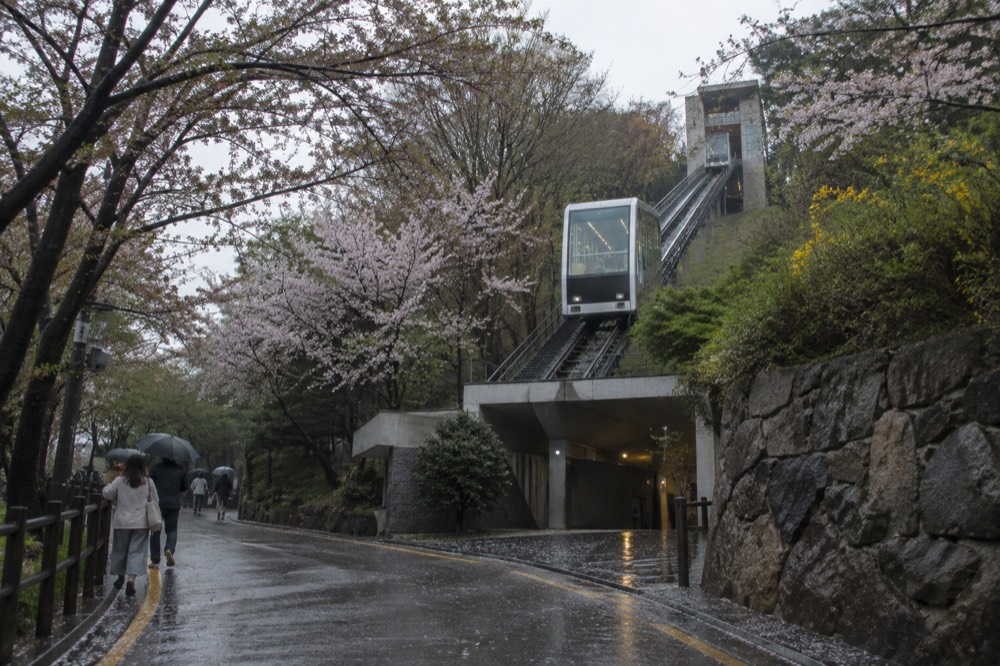
The observatory entrance sits at Plaza 5F, at the tower's base, with the information desk, ticket machine and gift shop beside it, and a second ticket booth at Tower 1F. Private cars cannot drive up Namsan: general vehicle access has been restricted since 1 May 2005. Visitors arrive on foot, by the Namsan circular buses 01A and 01B, by the Namsan cable car, or by the free Namsan Ormi inclined elevator.
The circular buses board at Chungmuro Station or Dongguk University Station and stop at N Seoul Tower, fare KRW 1,500, running 06:30 to 23:00 with 01A every 9 minutes and 01B every 14. The cable car runs 10:00 to 23:00 every day, adult round trip KRW 15,000, and its lower station is up the hill from Myeongdong rather than beside it. The Ormi, a glass-walled slanted outdoor elevator between Namsan Tunnel 3 and the cable car station, is free, runs 09:00 to 23:00, and is suspended every Monday from 09:00 to 14:00 for maintenance.
The walking routes have official times, but only the published ones. From Myeongdong Station Exit 4 via Banpo-ro to the cable car station is 590 m, about 12 minutes. From Hoehyeon Station Exit 1 through the underground shopping centre to the Ormi is 790 m, about 15 minutes. The summit trails from the library, the National Theater and the Sam-soon Steps take 30 to 40 minutes each per the tower owner's own figures. Anything beyond those, describe in words: uphill, steep, shaded, longer than it looks. The full route picture, including the new barrier-free Sky Forest Trail opened in October 2025, is in how to get to N Seoul Tower.
| Way up | Cost | Hours |
|---|---|---|
| Namsan circular bus 01A / 01B | KRW 1,500 | 06:30 to 23:00 window, 01A every 9 min, 01B every 14 min |
| Namsan cable car | KRW 15,000 adult round trip | 10:00 to 23:00 daily |
| Namsan Ormi inclined elevator | Free | 09:00 to 23:00, Monday maintenance 09:00 to 14:00 |
| Walking trails | Free | Park always open |
What can you see at the tower without an observatory ticket?
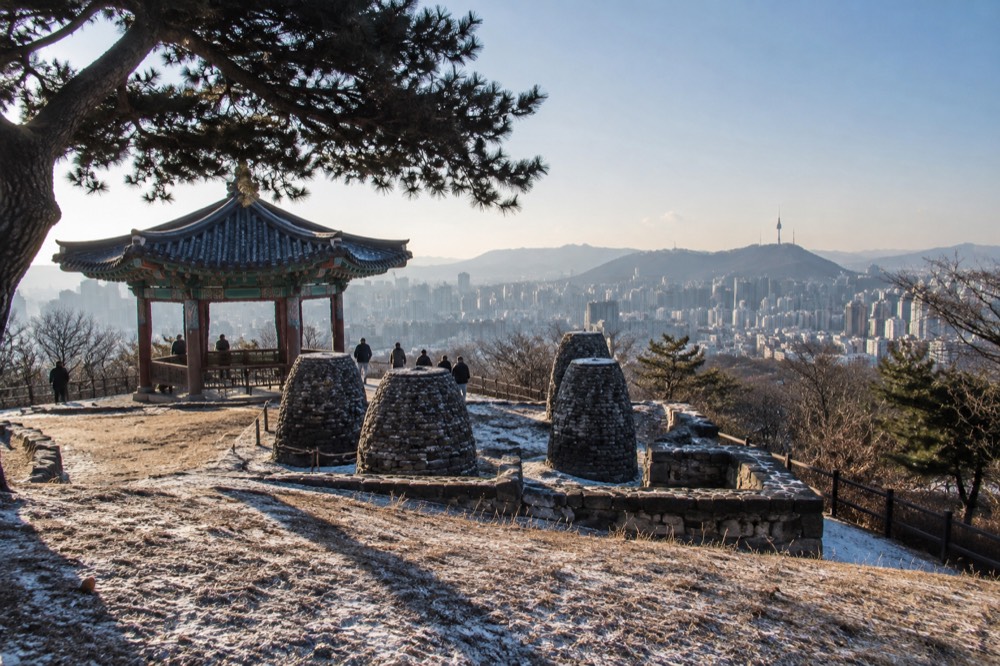
Everything except the deck. Namsan Park and its trails, the summit plaza, the terraces around the tower base, the love locks, the Bongsudae beacon mound, the Seoul City Wall path, the Seoul Tower Plaza shops and cafes, the Namsan Ormi elevator and the Myeongdong shuttle bus are all free. A visitor can reach the summit and see the view for nothing.
The paid items are the deck ticket, the cable car if you ride it, the circular bus fare, parking, food and shopping. This is the single most useful fact about the mountain, and Seoul's own tourism site answers it directly: the entrance to Namsan Park is free. The operator's FAQ reinforces it from the inside, directing visitors who bring their own food to the open plaza in front of Palgakjeong, and confirming that The Place Dining on Tower 2F needs no observatory ticket.
Around the base, the free list is long. The Bongsudae beacon mound is a restored Joseon-era signal station, Seoul Monument No. 14. The Seoul City Wall trail, Historic Site No. 10, runs from Sungnyemun to Jangchung Gymnasium. Baekbeom Square holds the Kim Koo statue, created 1968, and the Ahn Jung-geun Memorial Museum at 91 Sowol-ro opens 10:00 to 18:00 from March to October and 10:00 to 17:00 from November to February.
The love locks are part of this free zone, and they are active: Seoul's own new night walk, launched September 2026, routes walkers past the love lock deck by name, and the city's visitor page for the tower still lists the Locks of Love among its attractions. No removal programme has been announced, and no source says the locks are cleared on a cycle, but nothing more than that can honestly be claimed. The full story, including what visitors report about buying locks on site, is in the N Seoul Tower love locks guide.
How long should you spend, and how does the deck fit a Namsan visit?
Most visitors treat the observatory as one part of a Namsan visit rather than the whole of it: the deck itself, the plaza, the love locks and the walk up or down together fill an evening. The observatory's own hours, 10:00 to 22:30 or 23:00, set the outer limits, and last admission 30 minutes before closing sets the real deadline for the deck specifically.
The deck's total floor area, 2,403 square metres across its observation levels, is compact. What stretches a visit is the stack: the plaza retail floors at the base, the free Roof Terrace on Tower 2F, the paid deck levels, the telescopes, and, for those who book it, a rotating dinner that takes the better part of two hours to complete a single rotation. The cable car company's own recommended window is sunset into night view, though no official source publishes a sunset time or golden-hour figure, so plan by the season's daylight rather than a quoted hour.
For fitting the tower into a wider trip, the deck pairs naturally with Myeongdong below the mountain and with the city's evening programmes. Seoul's free guided night walk now ends at Palgakjeong with a deliberate link down toward Namdaemun Market for eating afterwards, which is the city's own suggested continuation. The broader planning picture is in what to do at Namsan Tower and how much time to spend at Namsan Tower.
A practical note on the fast-track option, since it appears above: the honest claim for it is that it skips the ticket counter. One buyer reported no visible fast-track lane, and nobody should buy it expecting a guaranteed shorter wait, because that is not what the product verifiedly does. What it does do is remove the counter step from your evening, which matters more on a weekend than a weekday morning.
The cocktail pairing, the last of the listing's options, suits the visitor whose plan is the evening deck and nothing else: entry plus a drink, watched over from the glass. Its price is on the live listing rather than quoted here. For anyone whose plan includes the ride up the mountain as well as the deck, the cable car bundle at US$28.05 covers both, with the Myeongdong pick-up before 18:00 as the one step to remember.
Common questions about the N Seoul Tower observatory
How much is the N Seoul Tower observatory ticket?
At the gate, the operator lists KRW 29,000 for adults, KRW 23,000 for children aged 3 to 12 and seniors 65 and over, free under 36 months. Online, the observatory ticket starts from US$15.25 per adult. Tickets are valid on the day of purchase only.
What are the N Seoul Tower observatory hours?
10:00 to 22:30 on weekdays and 10:00 to 23:00 on weekends and public holidays, open 365 days a year, with last admission 30 minutes before closing. The operator states hours can change with weather and Namsan vehicle-access restrictions.
Is everything at N Seoul Tower free except the observatory?
Yes. Namsan Park, the summit plaza, the terraces around the base, the love locks, the beacon mound, the city wall path, the Seoul Tower Plaza shops and cafes, the Namsan Ormi elevator and the Myeongdong shuttle bus are all free. The paid items are the deck ticket, the cable car if you ride it, the circular bus fare, parking, and food and shopping.
Does the observatory ticket include the cable car?
No. The cable car is a separate company with its own fare table, adult round trip KRW 15,000. Combined observatory-plus-cable-car products exist through resellers, not as an operator product, and the bundle requires collecting a physical ticket at a partner shop in Myeongdong before 18:00.
What is on the observatory floors?
Tower 4F and Tower 5F are the deck levels, with A Twosome Place, the Sky Restroom, N Gift, WeenyBeeny, N Photo and digital telescopes with zoom up to 36x. Tower 2F below them holds The Place Dining and the Roof Terrace, both reachable without a deck ticket, and Tower 7F above holds the rotating n.GRILL.
Can you eat inside N Seoul Tower without a ticket?
Yes, at The Place Dining on Tower 2F, which the operator's FAQ confirms needs no observatory ticket, and at the cafes and shops on Tower 1F and in Seoul Tower Plaza. Visitors bringing their own food are directed to the open plaza in front of Palgakjeong.