Namsan Tower at Night: Light-Up Times, Last Rides and the View After Dark
Namsan Tower at night is a different mountain: the deck stays open until 22:30 or 23:00, the cable car sells its last ticket half an hour before it closes, and nobody official publishes the moment the lights come on. Here is what is actually verified.
Short answer
The observatory stays open until 22:30 on weekdays and 23:00 on weekends and public holidays, with last admission 30 minutes before closing. The cable car runs to 23:00 with its last ticket at 22:30. No operator or city source publishes a light-up time; the tower is simply lit after dark.
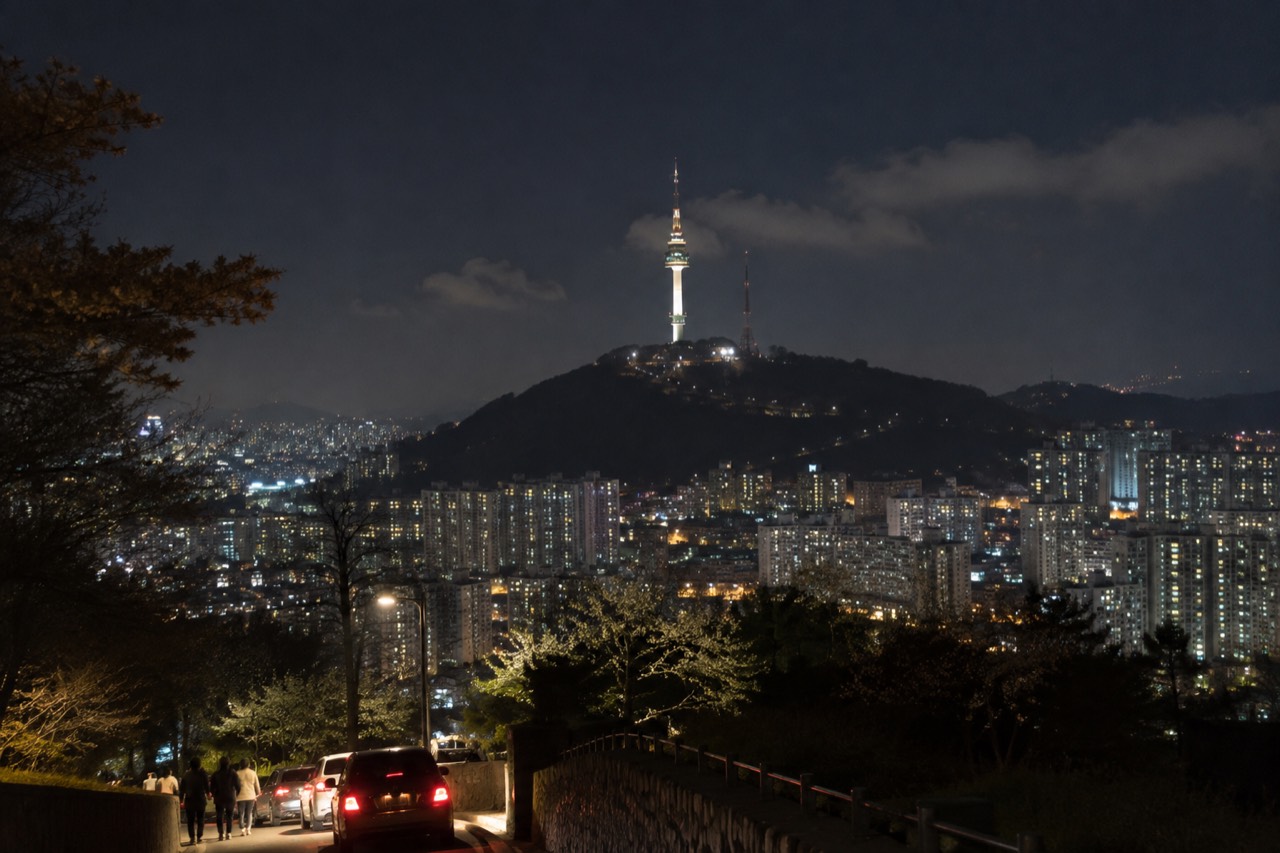
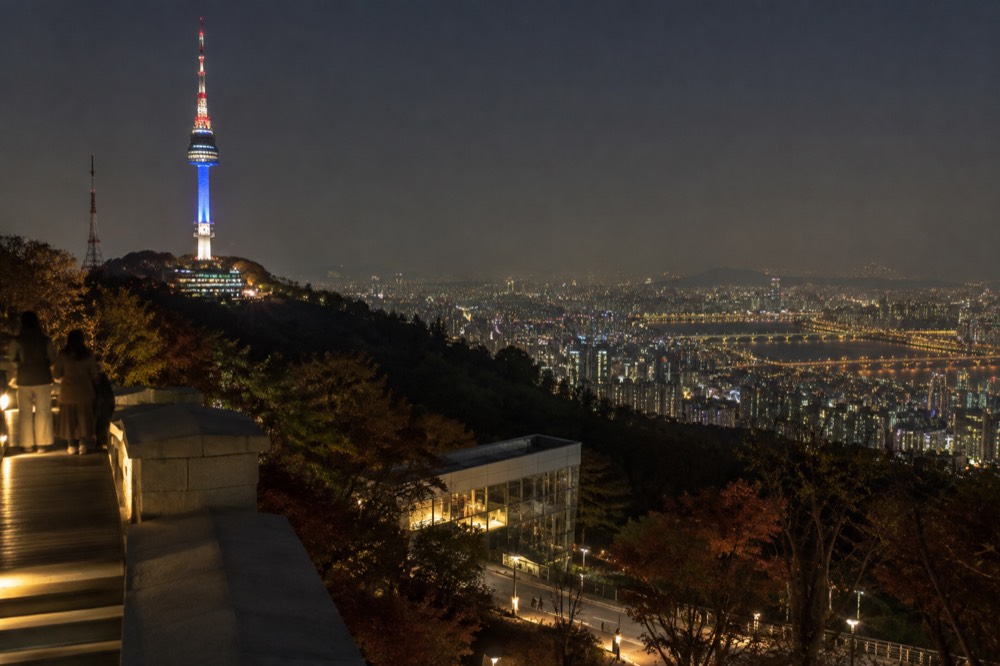
Namsan after dark is when the mountain earns its postcard. The tower, a 236.7 m structure standing on a 270 m hill above the middle of Seoul, switches from a grey landmark into a column of light that changes colour with the city's air. The summit plaza fills with couples and camera tripods, the cable car cabins glide up and down the roughly 600 m line until late, and the observatory inside the tower keeps selling tickets until half an hour before it shuts. None of that is guesswork: it all comes from the operator's own pages.
What is guesswork, and widely repeated as fact, is the exact minute the lights come on. That question, along with the last rides down, the free-versus-paid boundary at night, and how the night view genuinely differs from the day one, is what this guide settles. Everything below is drawn from the tower operator, the cable car company, YTN Seoul Tower and the Seoul Metropolitan Government, and where the official record is silent, this page says so plainly rather than inventing a number.
What actually changes on Namsan after dark?
After dark, the observatory keeps its full late schedule, the summit plaza and every terrace around the tower base stay free and open, the cable car and the Namsan Ormi elevator keep running toward 23:00, and the tower's exterior lighting comes on, though no official source publishes the moment it does. The paid part of the night is narrow: the deck ticket, the ride up, and anything you eat or buy.
The single most important thing to understand about a night visit is that the mountain and the tower are two different things. Namsan Park is free, open and public, and that does not change when the sun goes down. The summit plaza, the terraces around the tower base, the Palgakjeong pavilion area, the love lock deck, the beacon mound and the Seoul City Wall path all cost nothing at any hour. Seoul's own tourism site states it directly: the entrance to Namsan Park is free.
The ticket, if you buy one, buys the observation deck inside the tower and nothing else. At night that distinction matters more than during the day, because the free view from the base is already spectacular. Plenty of visitors come up in the evening, walk the plaza, watch the city glitter, and never pass a ticket gate. Others want the enclosed deck, the digital telescopes and the rotating restaurant above it. Both are legitimate ways to do Namsan Tower at night, and this guide covers each.
The evening also has a rhythm of its own now. From September 2026, Seoul runs a free guided night walk over the summit itself, with two fixed evening departures, which means the mountain after dark has a scheduled, city-run presence it never had before. That is covered in full further down, because it changes the answer to what a night on Namsan can be.
What time does Namsan Tower light up at night?
No tower operator, cable car company or city source publishes a light-up or switch-off time for the tower's exterior lighting. The times that circulate in third-party guides exist only in those guides and repeat each other. What is verified is that the tower is lit after dark, and that the lighting signals Seoul's air quality, a practice the operator dates to January 2011.
That is an uncomfortable answer for a planning guide to give, but it is the honest one. No operator page, tower lighting page or Seoul city page publishes a lighting schedule anywhere in the official record. The only fixed clock facts at night are the observatory's own hours: 10:00 to 22:30 on weekdays, 10:00 to 23:00 on weekends and public holidays, with last admission 30 minutes before closing. If you plan around those, the lighting will take care of itself, because the tower is lit once darkness falls and stays lit through the evening.
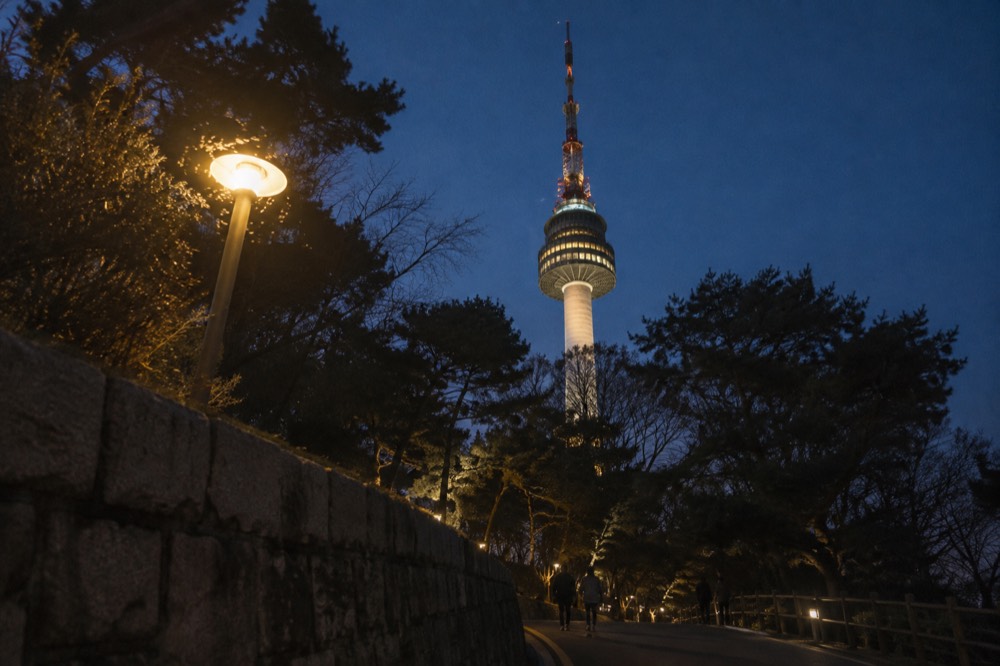
What the lighting does is more interesting than when it starts. Since January 2011, the colour of the tower body has signalled Seoul's fine-dust level, an idea the operator and the city run together. The specific colour code and its thresholds are not published in a verified form, so this page will not reproduce one; treat any colour chart you see elsewhere with caution. The tower is also used for one-off commemorative light-ups requested by outside bodies, for example a diplomatic anniversary lighting staged by the Korean and Japanese foreign ministries, which is a real and documented pattern distinct from the daily air-quality signalling.
If your whole plan hinges on seeing the tower lit from a distance rather than standing under it, the practical advice is simple: be in position after dark, not at a specific minute. The observatory's late closing means the lit tower is visible from across the city, from the Han River bridges to rooftops in Jongno, for the entire evening. For a deeper look at the question, the companion piece what time the Namsan Tower lights up works through the evidence in detail.
For visitors who do want the paid deck experience in the evening, the three main ticket options are compared below: the standard observatory ticket, the version bundled with the cable car, and a fast-track variant.
One thing worth saying about the bundle: it is a package put together by a reseller, not an official operator product, and it requires collecting a physical ticket at a partner shop in Myeongdong before you ride, with collection closing at 18:00. That collection deadline sits awkwardly with a late-evening plan, so read the listing carefully before choosing it for a night visit.
How do you get up and down Namsan at night?
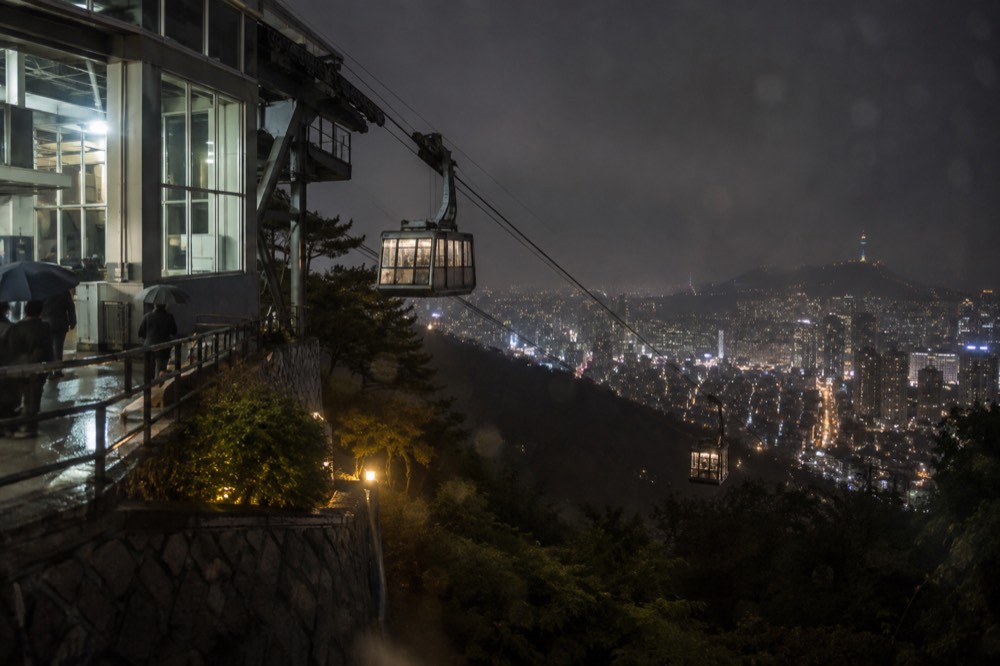
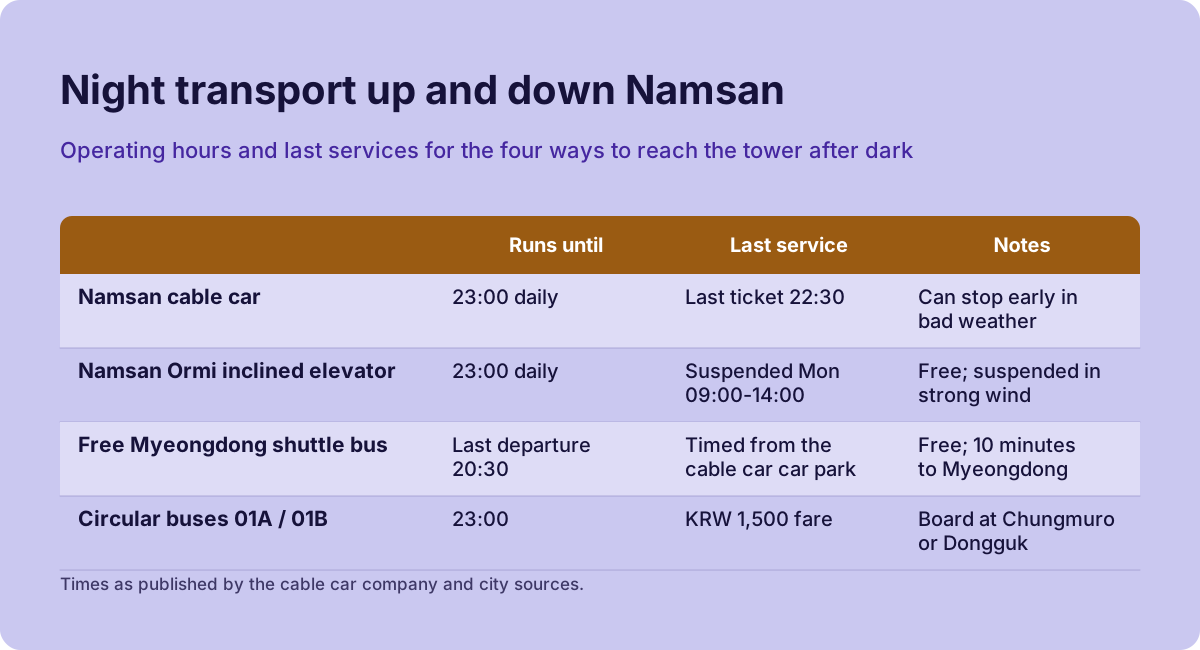
The cable car runs every day from 10:00 to 23:00 and sells its last ticket at 22:30. The free Namsan Ormi inclined elevator runs 09:00 to 23:00, pausing Monday mornings for maintenance. The free Myeongdong shuttle bus finishes earlier, with its last departure at 20:30, and the circular buses 01A and 01B run until 23:00.
The last ride down is the number night visitors actually need, and the cable car company publishes it clearly: the line operates every day of the year, 10:00 to 23:00, with the last ticket sold 30 minutes before closing, and service can stop early in bad weather. The Namsan Ormi, the glass-walled inclined elevator that lifts visitors from Namsan Tunnel 3 up to the cable car station free of charge, keeps the same 23:00 finishing time, though it is suspended every Monday from 09:00 to 14:00 for maintenance and also stops in strong wind or heavy rain.
| Night transport | Runs until | Last service | Notes |
|---|---|---|---|
| Namsan cable car | 23:00 daily | Last ticket 22:30 | Can stop early in bad weather |
| Namsan Ormi inclined elevator | 23:00 daily | Suspended Mon 09:00-14:00 | Free; also suspended in strong wind or heavy rain |
| Free Myeongdong shuttle bus | Last departure 20:30 | Timed from the cable car car park | Free; roughly 10 minutes to Myeongdong Station |
| Circular buses 01A / 01B | 23:00 | KRW 1,500 fare | Board at Chungmuro or Dongguk University stations |
The shuttle bus deserves its own sentence because it is the one people miss: the cable car company runs it free between Myeongdong Station and the cable car platform, but the last departure is 20:30, timed from the car park. Stay for the full evening and you will be walking down or riding the cable car instead. The circular buses, at KRW 1,500 with a transport card, are the budget route up from Chungmuro or Dongguk University stations and they keep going until 23:00.
Walking down is a real option and many people take it, but be honest with yourself about it. The official trail times on file are for the way up: 40 minutes up the Sam-soon Steps to Palgakjeong, 30 minutes from the Namsan Public Library, 40 minutes from the National Theater of Korea's ticket booth, and 30 minutes via the steps beside the theatre. Descending the same paths in the dark is steep, shaded and longer than it looks, and the city has now closed the unofficial side paths that walkers used to freestyle their way down, directing everyone onto the official trails. The guide to walking up Namsan covers the routes in daylight detail.
The observatory ticket itself, if the deck is your evening goal, is the same product at night as by day.
Is the night view from the observatory better than the day view?
The operator's verified visibility claim belongs to daylight: on a clear day you can see up to 50 km, naming Bukhansan to the north and Gwanaksan to the south. At night that range shrinks to the lit city itself, but the trade is real: Seoul's grid of lights, the Han River glowing through it, and the tower's own beam above you, which many visitors find more dramatic than any daytime panorama.
Neither view is objectively better, and pretending otherwise would be dishonest reporting. The day view is the one with distance in it: the operator's own FAQ states the 50 km clear-day visibility and names the landmarks, from Achasan and Ttukseom in the east to Yanghwa Bridge and Ilsan in the west. The night view is the one with density in it: the city below becomes a field of light, the river reads as a dark ribbon through it, and the deck's digital telescopes, LCD screens with optical zoom up to 36x on the Tower 2F roof terrace, Tower 4F and Tower 5F, let you pull individual districts close.
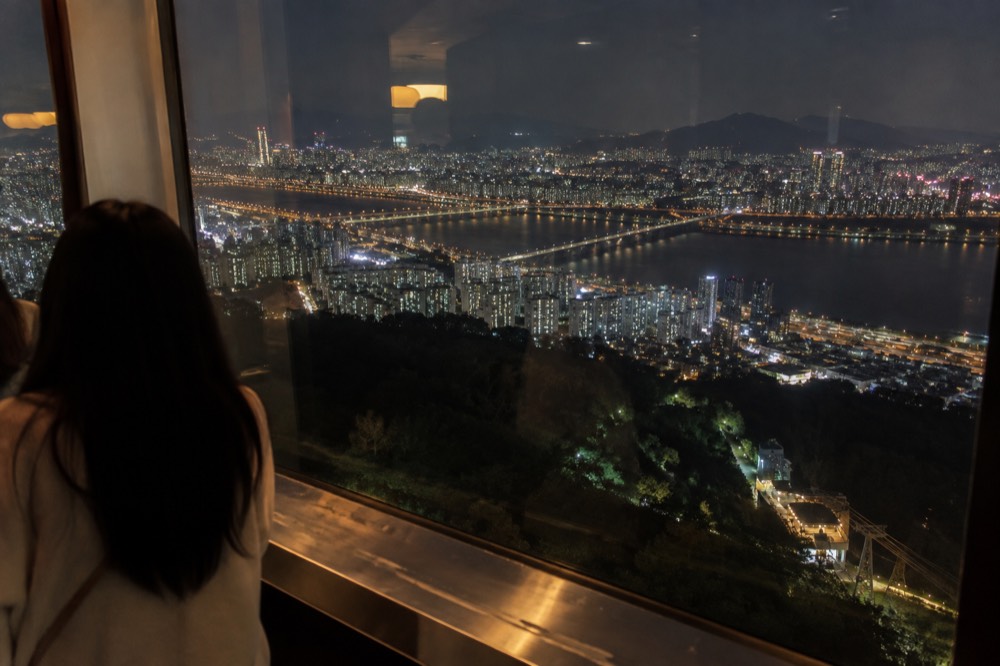
The cable car company's own guidance names sunset through to the night view as its recommended riding window, and states plainly that a night ride gives you Seoul's night scenery. That is a company talking up its own product, but the underlying point holds: the lit tower seen from a rising cabin, with the city opening underneath you, is the classic Namsan night image, and no official source contradicts it. What no official source does is name a sunset time or a golden-hour window, so this page will not either. Check the seasonal sunset for your date yourself and work backwards from the last rides.
Crowding follows a pattern visitors describe consistently through 2026: weekends, public holidays and evenings are the busy windows at both the tower and the cable car, while weekday visits and the early or late ends of the day are the quiet ones. No source anywhere states a wait in clock terms, and this page will not invent one. The honest planning version: a weekday evening is calmer than a Saturday evening, and the last hour before the deck closes is quieter than the middle of the evening.
For a night visit with a drink attached, there is an observatory-plus-cocktail option on the live listing. The price is on the listing itself rather than in this guide, because no verified figure exists for that bundle.
What can you do on Namsan at night for free?
Everything except the deck: the summit plaza and terraces, the love lock deck, the Palgakjeong pavilion area, the beacon mound and the city wall path are all free at night. New from September 2026, Seoul also runs a free guided night walk over the summit itself, with departures at 18:00 and 20:00 every day, led by a licensed city culture-and-tourism guide.
That night walk is the biggest change to Namsan evenings in years, and almost no published guide knows about it yet. Seoul's walking tour programme added a Namsan City Wall night course in September 2026, taking its night courses from nine to ten. The route, in the city's own description, starts at the Namsan Sky Forest Trail entrance near the Sowol poetry monument garden, passes the Zelkova Observatory, the Sunset Observatory and the Wellness Garden, then N Seoul Tower and the love lock deck, and finishes at Palgakjeong, deliberately placed for a descent toward Namdaemun Market so walkers can go and eat afterwards. It is free, it runs every day, and it is booked in advance through the city's own walking tour site rather than on the day. The rest of the planning pages sit on Namsan Tower Seoul.
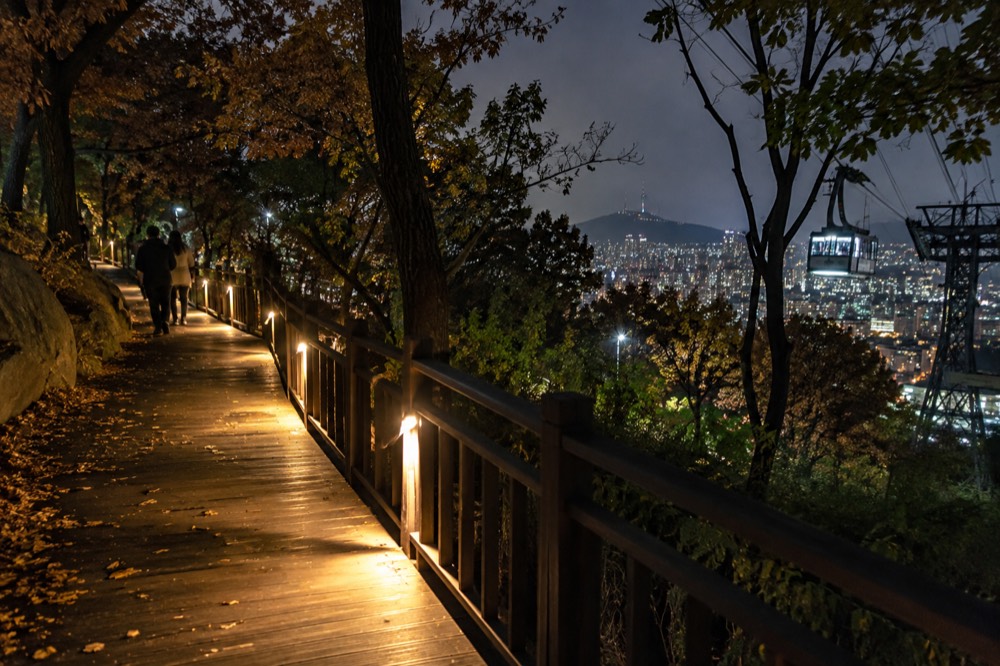
The trail it starts on is itself new. The city opened the Namsan Sky Forest Trail on 25 October 2025, a barrier-free timber deck path built with the Korea Forest Service so that wheelchair users, older visitors and anyone who cannot manage the steep old paths can get up the mountain. Named stops along it include a glass-fenced Sunset Observatory, the Wind View Bridge over a metasequoia stand, a Pine Rest Area and the Wellness Garden. It links the Huam-dong Namsan Fitness Center to the Namsan Library, and it now doubles as the start of the city's night tour.
| Free at night on Namsan | What it is |
|---|---|
| Summit plaza and tower-base terraces | Open ground around the tower, no ticket, lit in the evening |
| Love lock deck | On the city's own official night walk route |
| Palgakjeong pavilion area | The finish point of the city night walk, with a night view |
| Namsan Sky Forest Trail | Barrier-free timber deck path opened 25 October 2025 |
| Seoul City Wall path and beacon mound | Historic ground below the tower, free at all hours |
| Seoul Tower Plaza shops and cafes | Starbucks, GS25, Gong Cha and more, open to anyone |
Even the paid-adjacent parts of the base are free to enter. YTN Seoul Tower's plaza directory lists a full retail floor with a Starbucks, a GS25, a Gong Cha and several food outlets on Plaza 1F and 2F, all open to anyone without a ticket. The observatory entrance itself sits at Plaza 5F, and everything below and outside that gate costs nothing to stand in. The full breakdown of the free-versus-paid line is in is it free to go up Namsan Tower.
How do the observatory's night hours and prices work?
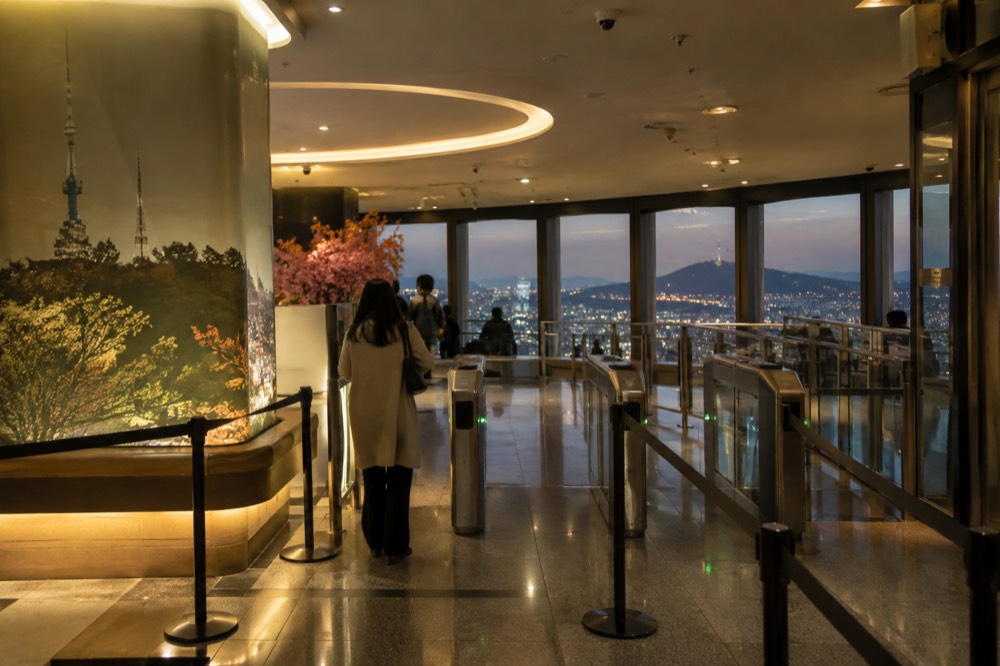
The observatory is open 365 days a year, 10:00 to 22:30 on weekdays and 10:00 to 23:00 on weekends and public holidays, with last admission 30 minutes before closing. An adult ticket is KRW 29,000 at the gate, or from US$15.25 through the live listing, which is rated 4.6 from 34,365 reviews. Tickets are valid on the day of purchase only.
Those hours come straight from the operator's own pages, in Korean and English, and Seoul's city government repeats them independently. The 30-minute last-admission rule is the one that catches people out at night: arrive at 22:29 on a weekday and the deck is closed to you, because the gate shut at 22:00. Plan to be inside well before the cut, or you will be viewing the city from the free plaza instead, which, as established above, is not a disaster.
| Ticket | Gate price | Notes |
|---|---|---|
| Adult, 13 and over | KRW 29,000 | Online from US$15.25, rated 4.6 from 34,365 reviews |
| Child, 3 to 12 | KRW 23,000 | Same as the senior rate |
| Senior, 65 and over | KRW 23,000 | |
| Under 36 months | Free | Limited to one child per accompanying adult |
Two gate prices and one online price appear above deliberately, side by side and unconverted, because that is the honest way to present them. The online option is the same deck, bought ahead through the operator's live listing; it skips the ticket counter, not any other queue, and riders still queue for the cable car like everyone else. There is also a fast-track variant at US$40.85, though one buyer reported no visible fast-track lane at the entrance, so treat the name cautiously and read the listing before paying extra for it.
Two restaurant routes into the deck exist for evening visitors who would rather eat than queue for a ticket window. An advance n.GRILL reservation includes free observatory admission, and dining at HanCook gets a discount on the deck ticket. The rotating n.GRILL, one full rotation every 1 hour 40 minutes, is the operator's flagship on Tower 7F, open 12:00 to 22:00 with last order at 20:00. The full food picture, including the burger house that replaced N Burger after its March 2026 renewal, is in the guide to restaurants at N Seoul Tower.
The standard observatory ticket, the one most evening visitors want, is here:
What are the love locks and the summit plaza like after dark?
The love lock deck is on Seoul's own official night walk route, which settles that it is neither removed nor off limits, and the summit plaza around the tower base is free, lit and open all evening. Padlocks are still sold at the tower, according to 2026 visitor accounts, and no operator, city or news source has announced any removal programme for the locks.
That last point answers the question people quietly worry about. No announcement of a periodic clear-out, a scheduled cutting, a weight or safety programme or a recycling scheme for the locks has been published, and no source says otherwise. The honest position, in plain words: no removal programme has been announced, and no source says the locks are cleared on a cycle. The strongest fresh evidence that the ritual is alive is structural rather than anecdotal: Seoul's brand-new city night walk, launched September 2026, routes walkers past the love lock deck by name, between the tower and Palgakjeong. A city government does not put a closed attraction on an official guided route.
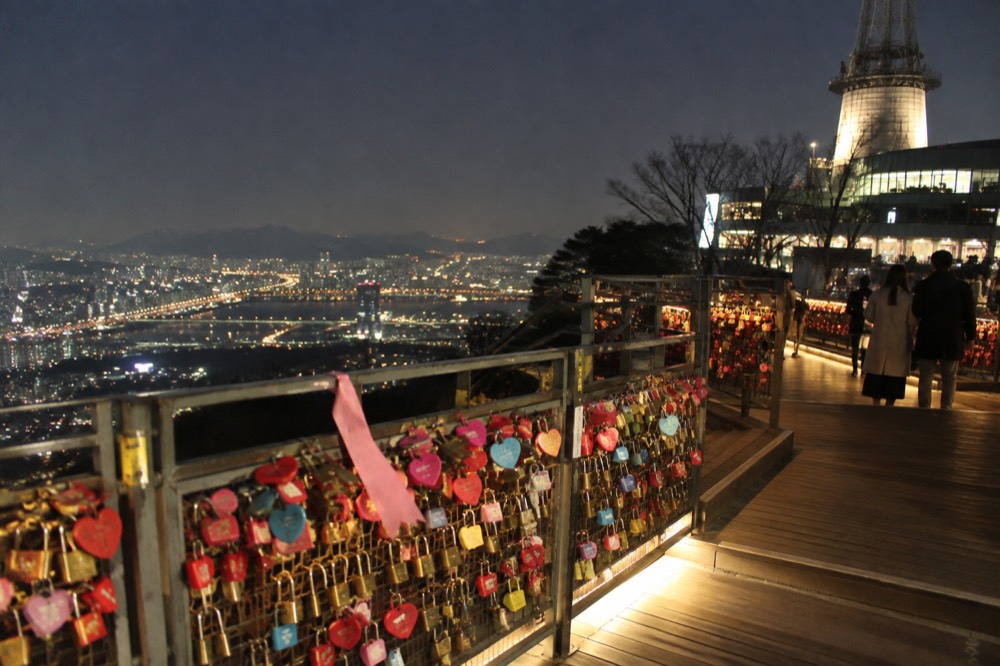
At night the deck has a different character than by day. Visitors describe the railings as a wall of small reflections under the plaza lighting, with the city glowing behind them, and 2026 accounts describe buying locks on site, including branded locks engraved there and then. Where the locks are sold and what they cost is not verified, so this page leaves it there. The deeper story of the ritual, and the honest answer to whether it is under threat, is in can you still put locks on the love lock bridge.
The plaza itself is the night venue most visitors underuse. The operator's FAQ directs people who bring their own food to the open plaza in front of Palgakjeong, which tells you it is treated as public picnic ground. The whole area is non-smoking under the National Parks Act, with a stated fine of KRW 100,000, and pets are allowed in the shared plaza area if leashed and cleaned up after, though not inside the tower itself. Wheelchairs and strollers can be borrowed at the information desk. In other words, the free summit works as an evening destination in its own right, with or without a deck ticket.
Is Namsan Tower at night worth it, and how should you plan it?
Yes, for most visitors, because the night combines the free lit summit, a deck open to 22:30 or 23:00, and a cable car running until the same hour, all in one compact evening. Plan around three numbers: last admission 30 minutes before the deck closes, the cable car's last ticket at 22:30, and the shuttle bus finishing at 20:30.
The night-versus-morning question is genuinely close, and the honest comparison lives in is it better to go to Namsan Tower at night or morning. The short version: morning gives you the clear-day 50 km visibility and thinner crowds; night gives you the lit city, the lit tower, the later closing time and, since September 2026, a free guided city walk over the summit. Neither is wrong, and the evening has quietly become the richer programme.
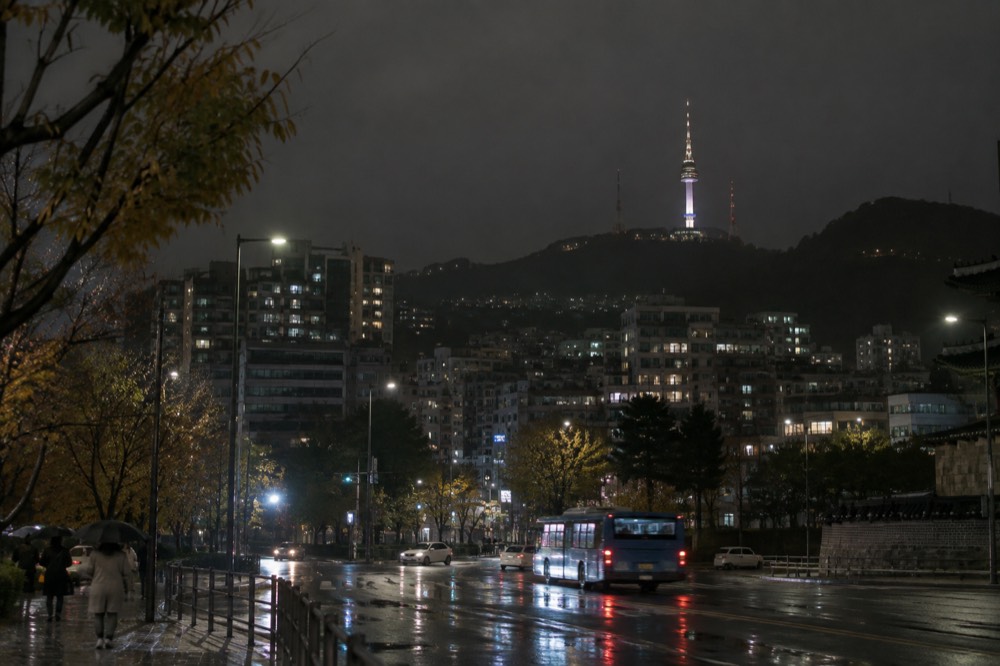
One cultural footnote that matters more than it used to: the tower's night image now travels through film. Netflix's own locations guide for KPop Demon Hunters, released 20 June 2025, gives the tower its own section and stages the film's climax at a fictional stadium beneath it, with writer-director Chris Appelhans describing the tower as a beacon at the heart of the city summoning everybody. Seoul's mayor has publicly tied Namsan's visitor surge to the film, and the Korea Times has reported visitors retracing its Seoul trail, headed at N Seoul Tower. If you meet extra evening crowds on the summit, a demon-hunting cartoon is part of why. The full story is in N Seoul Tower on screen.
For the deck itself, the fast-track option is the one evening variant that divides opinion, given the buyer who reported no visible fast-track lane. It is listed below for completeness.
However you buy, the evening structure stays the same: ride or walk up, spend time on the free plaza while the sky darkens, enter the deck before the 30-minute cut, and be at the cable car or the trailhead before the last service. The three main ticket options, gathered in one place for a final decision:
Common questions about Namsan Tower at night
What time does Namsan Tower light up?
No official source publishes a light-up time. The tower is lit after dark, and the only fixed clock facts are the observatory's own hours: 10:00 to 22:30 on weekdays and 10:00 to 23:00 on weekends and public holidays, with last admission 30 minutes before closing.
What is the last cable car down from Namsan at night?
The cable car runs every day from 10:00 to 23:00 and sells its last ticket at 22:30. Service can stop early in bad weather. The free Namsan Ormi inclined elevator also runs until 23:00, except for its Monday morning maintenance suspension.
Is the Namsan summit free at night?
Yes. Namsan Park, the summit plaza, the terraces around the tower base, the love lock deck, Palgakjeong and the city wall path are all free at any hour. Only the observation deck inside the tower, the cable car or bus ride, parking, and food and shopping cost money.
How late is the observatory open?
The observatory is open 365 days a year, until 22:30 on weekdays and 23:00 on weekends and public holidays, with last admission 30 minutes before closing. An adult ticket is KRW 29,000 at the gate, or from US$15.25 online.
Can you walk down from N Seoul Tower at night?
Yes, and many do, but the official trails are steep, shaded and longer than they look. The city has closed the unofficial side paths and directs walkers onto the official trails only, so follow the marked routes down toward Myeongdong, the library or the National Theater.
Is there a free night tour of Namsan?
Yes, since September 2026. Seoul runs a free guided night walk over the summit with departures at 18:00 and 20:00 every day, passing N Seoul Tower and the love lock deck and finishing at Palgakjeong. It is booked in advance through the city's own walking tour site.