Where to take the best N Seoul Tower photos: every angle that works
The tower photographs well from almost everywhere on Namsan, but a handful of spots do most of the work: the lock terrace, the base looking straight up, the stair approaches from the bus stop and two evening angles. Here is where each one is, what it costs to reach and how to plan around the light.
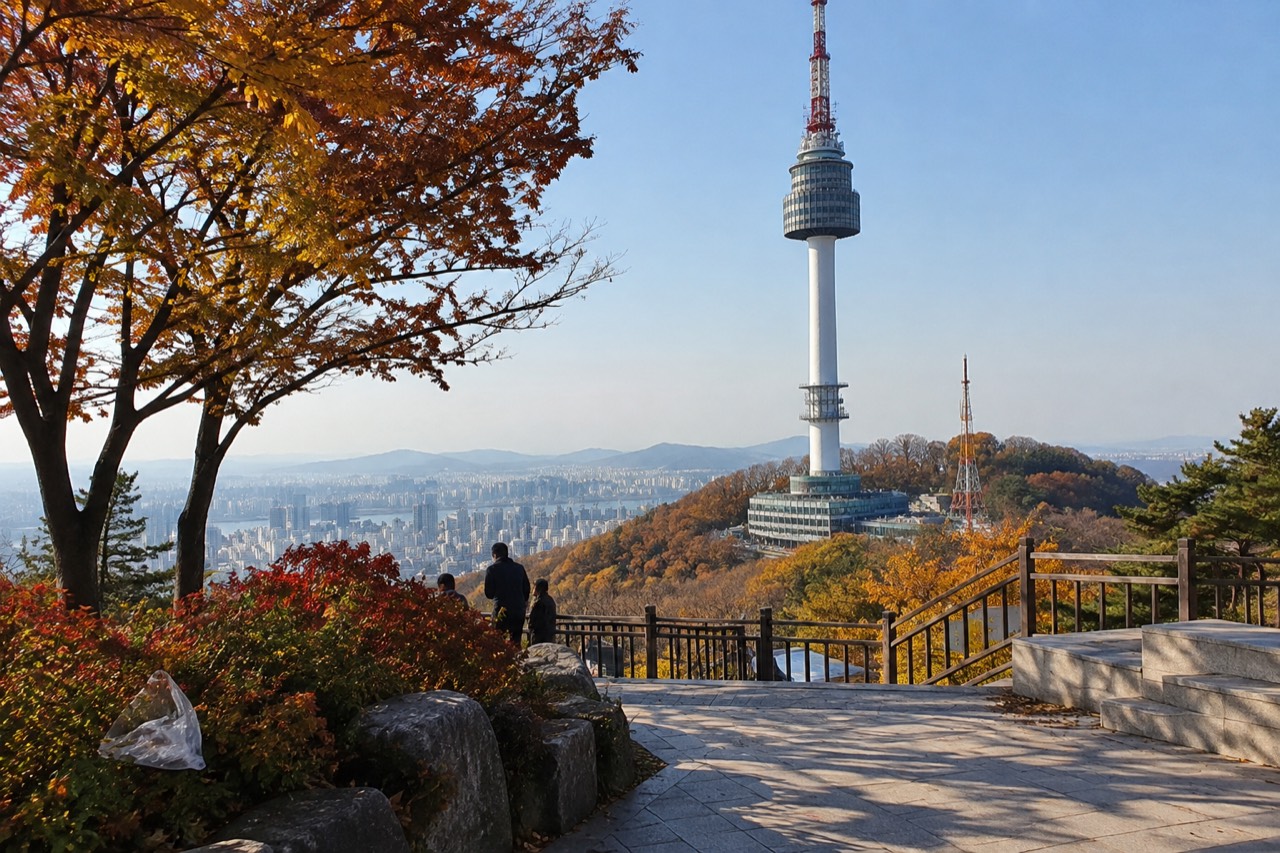
Short answer
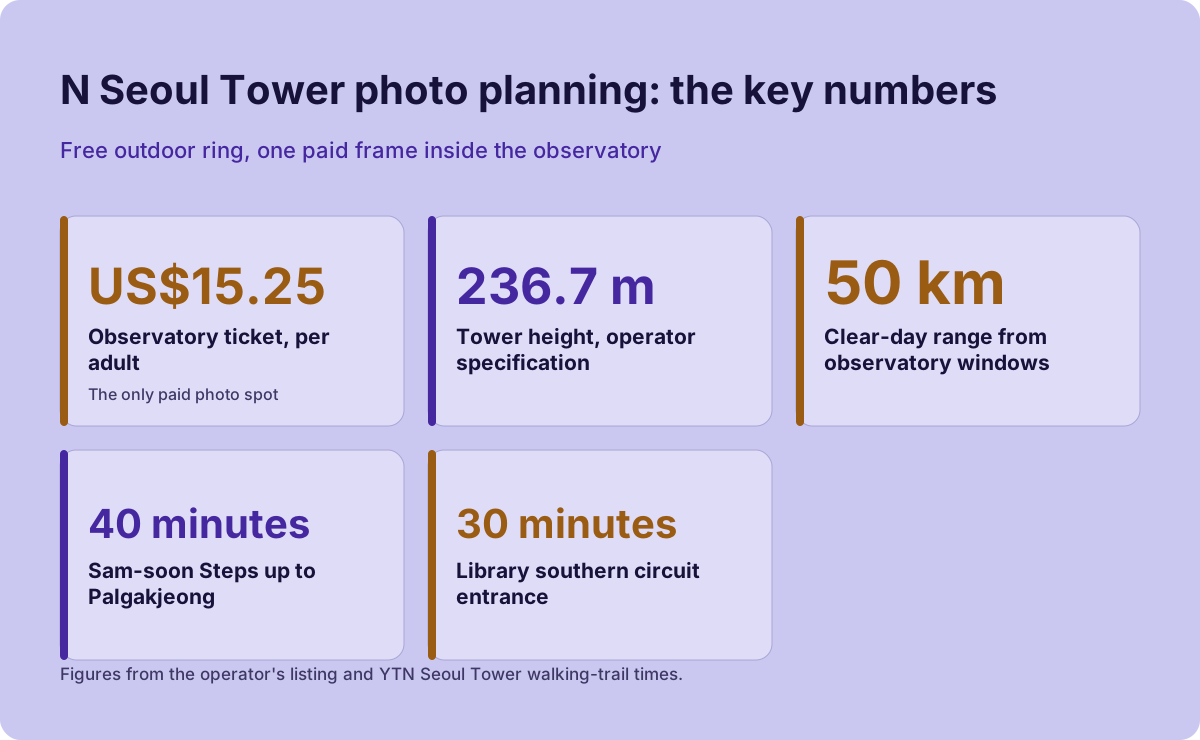
The strongest N Seoul Tower photos come from free ground on the summit: the lock terrace, the terraces around the tower base and the stair approaches from the bus stop. The observatory at US$15.25 per adult adds the window and skyline shots. The tower is lit after dark, though no operator or city source publishes a switch-on time.
The most useful thing to know before planning N Seoul Tower photos is that the mountain is free and the tower is not. Every outdoor angle on this page, the lock terrace, the terraces around the base, the stairs, the beacon mound, the city wall path, costs nothing to stand on. The only paid frame is the one from inside the observation deck, at US$15.25 per adult for the standard option on the live listing. Everything else is a question of light, legs and timing.
This guide walks the summit in the order a photographer would. It starts with the two spots most visitors come for, moves through the approaches that give the tower its scale, then covers the paid interior frames and the two angles that read best after dark. Where a fact matters, like the observatory's published closing time or the free status of the plaza, it comes from the operator or the city. Where nothing official exists, like a lighting switch-on time, this page says so plainly rather than repeating a number a third-party guide invented.
Where are the best photo spots at N Seoul Tower?
The best photo spots split into two rings: a free outer ring on the summit plaza and a paid inner ring inside the observatory. The outer ring includes the lock terrace, the terraces around the tower base, the stairs up from the bus stop, the Bongsudae beacon mound and the Seoul City Wall path. The inner ring is the observatory itself, at US$15.25 per adult, with its window frames and digital telescopes.
The outer ring is bigger than most visitors expect. Seoul's own April feature on Namsan groups the park trail, the Locks of Love, the heart chairs, the photo booths and the Palgakjeong night view together as things to do on the mountain, and prices only the observatory. That is the cleanest statement of the boundary from any official source, and it matches the operator's own floor guide: the observatory entrance sits at Plaza 5F, and every shop, cafe and terrace below and outside that gate is open without a ticket.
For photographers this changes the planning math. A visitor who only wants the tower in frame can spend a whole golden evening on the mountain and spend nothing. A visitor who wants Seoul spread out behind glass needs the deck ticket, and the deck has its own best hours. The two rings also have different crowds: the plaza fills with couples and families doing the locks and the photo booths, while the deck runs steady from its 10:00 opening to last admission 30 minutes before closing.
| Photo spot | Where it is | Ticket needed | What it gives you |
|---|---|---|---|
| Lock terrace | Between the tower and Palgakjeong | No | Padlock texture, tower close-up, ritual shots |
| Tower base terraces | Around Plaza 5F | No | The tower from below, plaza life, skyline |
| Stairs from the bus stop | Southern approach to the summit | No | The tower framed by steps and trees |
| Bongsudae beacon mound | Below the tower at Palgak Square | No | Joseon-era signal station, historic foreground |
| Seoul City Wall path | Sungnyemun to Jangchung Gymnasium | No | Wall foreground, tower at distance |
| Observatory windows | Tower 4F and 5F | Yes, US$15.25 adult | Skyline through glass, 50 km clear-day range |
| Roof terrace | Tower 2F | No | Open-air frames, digital telescope |
One more framing note before the spot-by-spot detail. The tower is a working broadcast and communications tower, and Netflix's own locations guide for KPop Demon Hunters points out that this is exactly why the film uses it as a transmitter of something else. The tower's silhouette reads as Seoul in a way few structures do, which is why the base-and-skyline compositions below are worth the walk even for photographers who never buy a deck ticket. The on-screen story is covered in full in N Seoul Tower on screen.
The lock terrace and the tower base looking up
The lock terrace is the single most photographed free spot on the summit, a railing of padlocks between the tower and Palgakjeong that the city itself now routes its guided night walk past. The tower base, a few minutes around the plaza, gives the opposite frame: the structure from below, with the plaza's terraces and the skyline behind. Both need no ticket.
The locks are active and officially part of the mountain's offer. Seoul's visitor page for the tower still lists the Locks of Love among its attractions, and the city's new Namsan City Wall night course, launched in September 2026, routes walkers past the love lock deck by name between N Seoul Tower and Palgakjeong. A city government channel putting the locks on an official route settles that they are neither removed nor off limits. Visitors report buying padlocks on site, including branded locks engraved there, though nothing verified exists about where they are sold or what they cost, so this page does not guess. The full story of the ritual, and the honest answer on whether the locks are ever cleared, is in N Seoul Tower love locks.
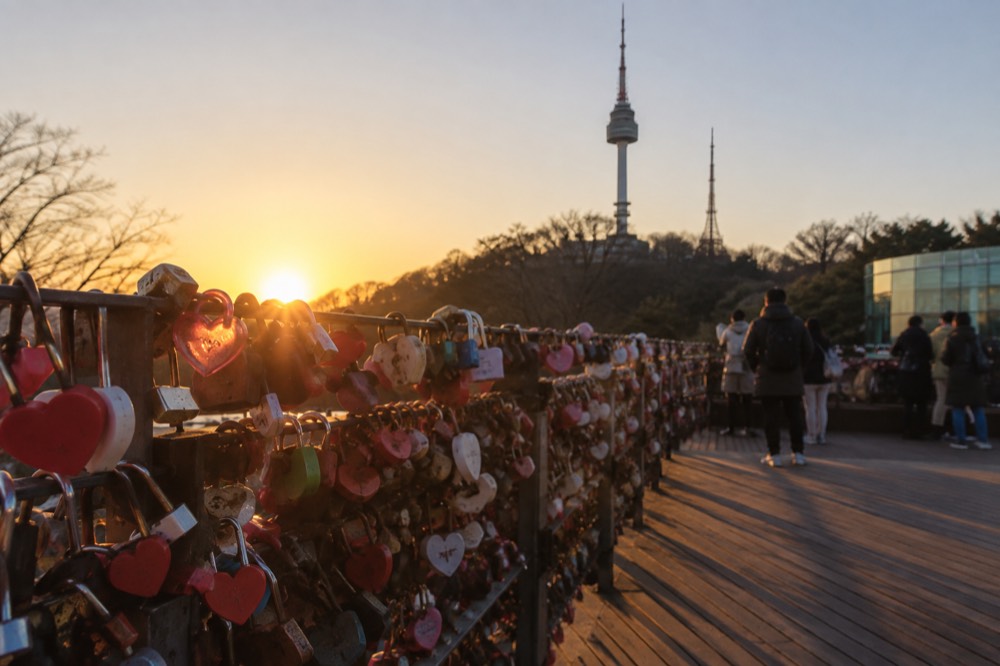
Photographically the lock terrace works two ways. Close, the locks are texture: rows of engraved metal, colour against colour, with hands and fresh locks as human detail. Pulled back, the railing becomes a foreground band with the tower rising directly behind it, which is the composition most visitors are actually reaching for. The terrace is busiest in the evening, when the cable car's queues and the plaza both fill, so photographers wanting the railing to themselves should treat the weekday early opening hours as the window.
The base is the other half of this pair. Standing on the terraces around Plaza 5F and aiming upward gives the tower's full 236.7 m structure, the operator's own specification figure, compressed against the sky, with the plaza's cafes and the N Terrace bar in the mid-ground. YTN Seoul Tower's plaza directory lists a full retail floor open to anyone, Starbucks, GS25, bhc Chicken, Gong Cha and more on Plaza 1F and 2F, which means the base shots come with somewhere warm to wait for the light to change. The plaza is also where the tower's evening lighting does its work, though it is worth being clear about what is and is not known there.
| Frame | Best light | Crowds | Ticket |
|---|---|---|---|
| Lock railing close-up | Any time, overcast softens glare | Evening busiest | Free |
| Locks with tower behind | Late afternoon into evening | Evening busiest | Free |
| Tower from base, straight up | Blue hour for sky balance | Steady all day | Free |
| Plaza life and cafes | Daytime | Lunch peak | Free |
| Palgakjeong night view | After dark | Evening groups | Free |
On the lighting: the tower is lit after dark, and that is the honest limit of what any source can say. No operator, tower or Seoul city page publishes a time for when the exterior lighting comes on or goes off, so plan to be at the tower after dark rather than chasing a schedule. The switch-on times that circulate widely online exist only in third-party guides that repeat each other. The observatory's own published closing time, 22:30 on weekdays and 23:00 on weekends and public holidays, is the only fixed clock fact on the mountain, and it is the anchor every evening plan should hang from.
If the paid interior frames are part of the plan, the options below are the three that matter for photographers: the standard deck ticket, the fast-track version and the deck-plus-cable-car package.
The stairs from the bus stop and the summit approaches
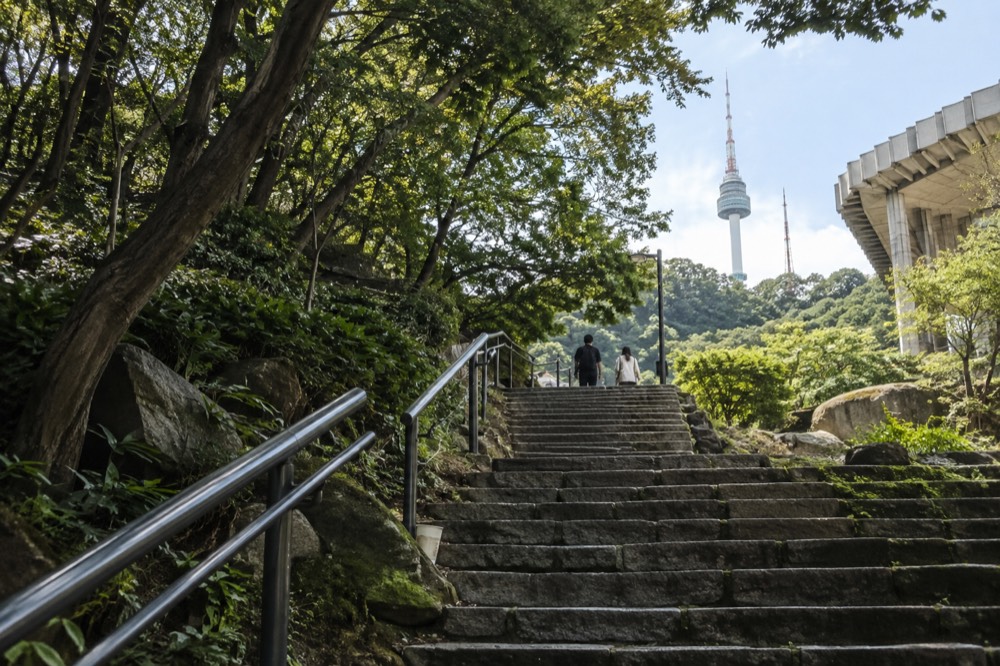
The stair approaches give the tower its scale, and the best of them are the stone steps from the southern bus stop area and the Sam-soon Steps beside the Seoul Education Research and Information Institute, which YTN Seoul Tower times at 40 minutes up to Palgakjeong. The new Namsan Sky Forest Trail, opened 25 October 2025, adds a barrier-free timber deck with named photo points including a glass-fenced Sunset Observatory.
The stairs are the underrated frames. The steps from the bus stop area climb through trees toward the summit, and the tower appearing at the top of a flight of steps is a composition that costs nothing but the climb. YTN Seoul Tower's own walking-trail times list four official routes: the Sam-soon Steps at 40 minutes, the Namsan Public Library southern circuit entrance at 30 minutes, the National Theater route at 40 minutes and the steps beside the National Theater at 30 minutes. Those are the only sourced walk times on the mountain; every other route should be judged by eye, uphill, steep, shaded, longer than it looks.
The Sky Forest Trail is the genuinely new material. The Seoul Metropolitan Government opened it on 25 October 2025, a barrier-free timber deck path built with the Korea Forest Service so that wheelchair users and older visitors can get up Namsan, linking the Huam-dong Namsan Fitness Center to the Namsan Library. Its named stops read like a shot list: the Sunset Observatory, a glass-fenced sky-view photo point, the Wind View Bridge over a metasequoia stand, a Pine Rest Area, a Wellness Garden with a Starlight Marronnier Forest and meditation gardens, and Sowol Garden at the library entrance, built around the Kim Sowol poetry monument. The city's night-tour page adds a Zelkova Observatory. The barrier-free summit trail opened in October 2025.
Two cautions come with the approaches. First, the city closed the unofficial side paths worn into Namsan as part of the same works, ecologically restored them, and now directs walkers onto the official trails only, so freestyling uphill is no longer an option. Second, private cars cannot drive up at all: general vehicle access has been restricted since 1 May 2005, and tour-bus access to the circular road since August 2021, so the stairs and the shuttle are the mountain's front doors. The full transport picture, including the free Ormi inclined elevator and the circular buses, is in How to get to N Seoul Tower, and the walking routes in detail in Namsan Park walk up.
Inside the observatory: windows, telescopes and the rotating floor
The observatory's photo value is the skyline through glass and the digital telescopes, which the operator specifies with optical zoom up to 36x on the Tower 2F roof terrace, Tower 4F and Tower 5F. The deck spans observation levels totalling 2,403 square metres, and the operator states a clear-day visibility of up to 50 km, naming Achasan and Ttukseom east, Bukhansan north and Gwanaksan south.
The interior frames are a different discipline from the plaza. Glass reflections are the enemy, so the practical advice is to shoot close to the pane, shade the camera with a hand or body, and prefer the blue-hour window when the city lights are up but the sky still has colour. The operator's clear-day list is the useful planning tool: on a genuinely clear day the deck claims sightlines from Achasan and Ttukseom in the east to Yanghwa Bridge, Nanjido and Ilsan in the west, Gwanaksan and the Seoul Arts Center south, and Bukhansan and Cheonggyecheon north. On a hazy day, the closer skyline is the realistic subject.
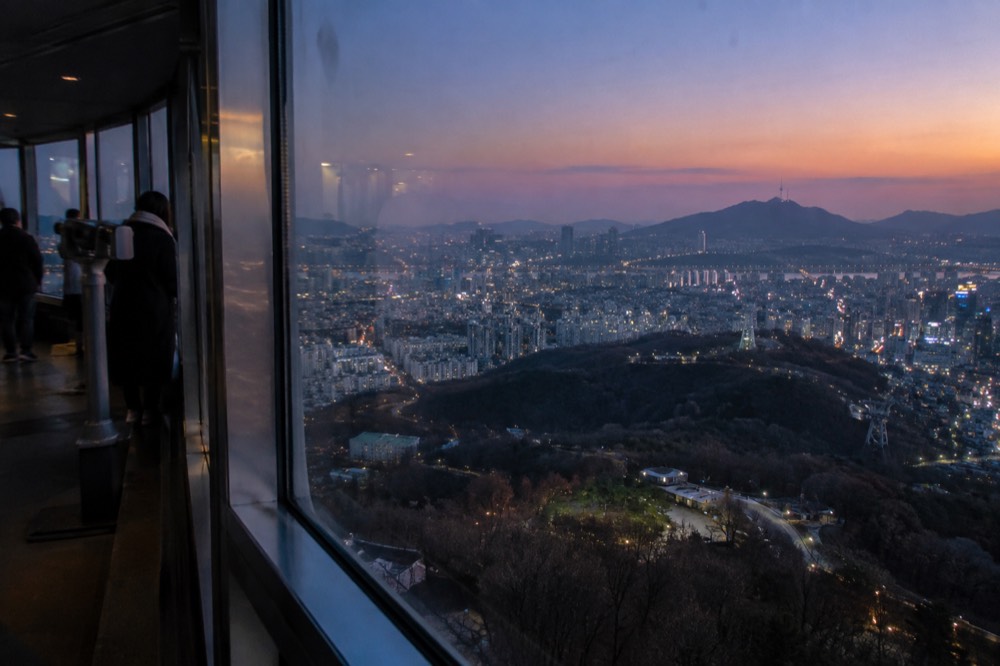
The digital telescopes deserve their own sentence. They are LCD screens with optical zoom up to 36x, per the operator's observatory page, and they let a photographer scout distant detail, a bridge, a stadium, a hilltop, before committing to a long lens. The Sky Post Office rounds out the interior's quieter shots: postcards and stamps are sold at the observatory's Tower Gift, with the operator stating domestic delivery in 2 to 3 days and overseas in about 15 days, which makes a mailed postcard both a photo subject and a souvenir in one.
| Interior frame | Where | Notes |
|---|---|---|
| Skyline through glass | Tower 4F and 5F | Shoot close to pane, blue hour best |
| Digital telescope screen | Tower 2F roof terrace, 4F, 5F | 36x zoom, scouting tool |
| Rotating restaurant view | Tower 7F, n.Grill | One rotation takes 1 hour 40 minutes |
| Open-air terrace | Tower 2F roof terrace | No glass, no observatory ticket needed |
| Gift shop and post office | Tower 5F and Plaza 5F | Postcards, 2 to 3 days domestic delivery |
One floor worth singling out for photographers who do not want the ticket at all: The Place Dining on Tower 2F is reachable without an observatory ticket, per the operator's own FAQ, and the Roof Terrace on the same floor carries a digital telescope. That makes Tower 2F the one interior-adjacent frame that stays free. The standard deck ticket, rated 4.6 across 34,365 reviews on the live listing, is the option below.
The two spots that read best after dark
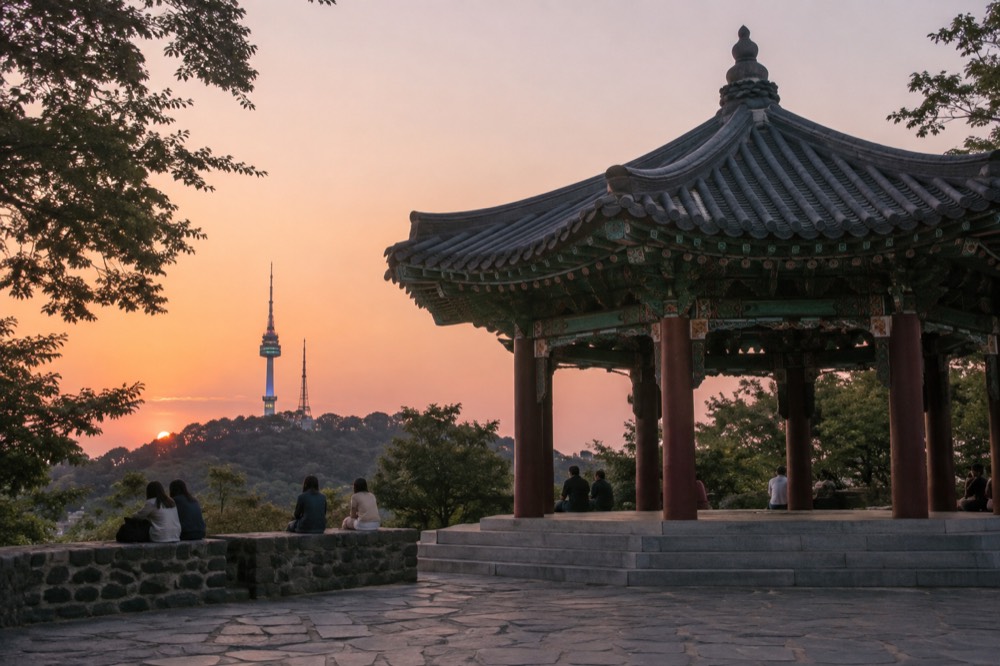
After dark, the two spots that read best are the Palgakjeong pavilion area looking back at the lit tower, and the lock terrace with the tower's lighting behind the railings. The city's own feature groups the Palgakjeong night view with the free things on the mountain, and the observatory's 22:30 weekday and 23:00 weekend closing, with last admission 30 minutes earlier, sets the outer limit of any evening plan.
Palgakjeong is the night anchor. The Seoul Metropolitan Government's April feature on Namsan names the Palgakjeong night view outright as one of the mountain's draws, alongside the trail, the locks, the heart chairs and the photo booths, and prices only the observatory. From the pavilion area the lit tower sits above the tree line, and the plaza in front of Palgakjeong is the ground the operator itself directs picnicking visitors to, which tells you it is open, settled space rather than a squeeze on a path.
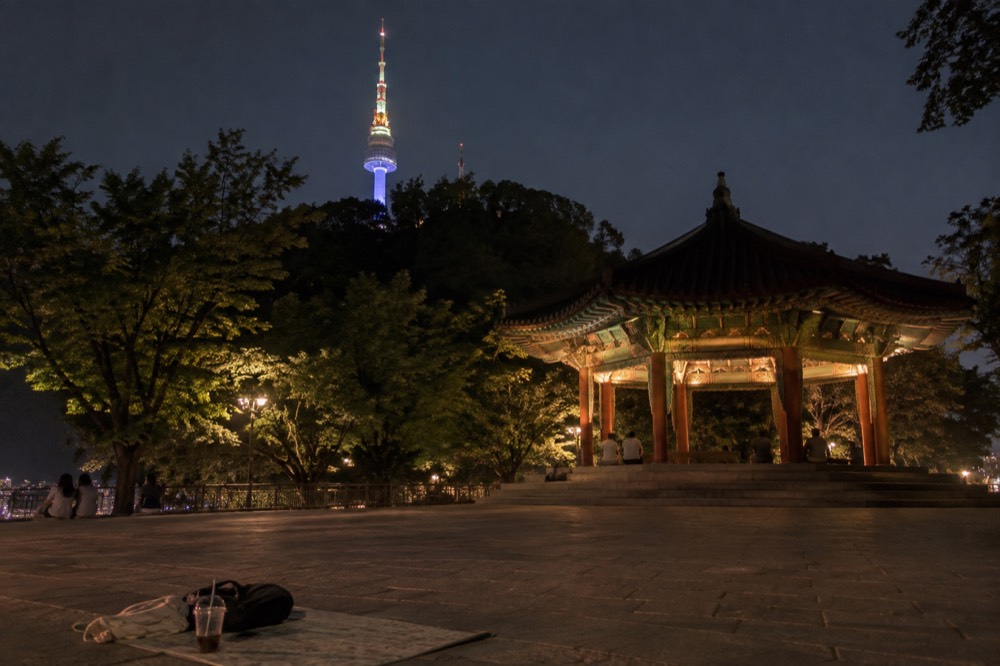
The lock terrace after dark is the second frame. The city's new guided night walk, launched in September 2026 with departures at 18:00 and 20:00 daily, routes past the love lock deck by name on its way from the Sky Forest Trail entrance to Palgakjeong, which confirms both that the terrace is open and used in the evening and that the summit now has a scheduled group moving through it. The walk is free, led by a licensed city culture-and-tourism guide, and booked in advance through the city's own walking-tour site. For a photographer it is also a subject: a line of walkers with lamps crossing the summit is a frame that did not exist a year ago.
What cannot be planned to the minute is the lighting itself. The tower's lighting does come on after dark, and it is used both for the air-quality signalling the operator dates to January 2011 and for one-off commemorative light-ups, such as the Korean and Japanese foreign ministries' lighting for the sixtieth anniversary of diplomatic relations. But no operator or city source publishes a switch-on time, and the colour code behind the air-quality signalling is not verified, so this page will not repeat either. The honest evening plan is built on the fixed facts: the observatory's closing time, the night walk's two departures, and the cable car's 10:00 to 23:00 operating hours with last ticket 30 minutes before closing. More on the evening mountain is in N Seoul Tower at night.
Planning the shoot: light, crowds and what to carry
Plan around three fixed clocks: the observatory opens at 10:00 and closes at 22:30 on weekdays and 23:00 on weekends and public holidays, with last admission 30 minutes earlier; the cable car runs 10:00 to 23:00 daily; and the city night walk departs at 18:00 and 20:00. Crowding, as visitors report it, clusters on weekends, public holidays and evenings, leaving weekday mornings and the late edges of the day quieter.
The gear question is simpler than most city shoots. The plaza and terrace frames need a standard zoom and patience; the base-looking-up compositions reward a wide lens; the interior glass work rewards a lens that focuses close and a cloth for the pane. The mountain's rules are worth knowing in advance: the whole area is non-smoking under the National Parks Act with a stated fine of KRW 100,000, outside food is not allowed inside the tower itself, with the operator directing packed meals to the plaza in front of Palgakjeong, and pets may not be brought into N Seoul Tower, though YTN Seoul Tower allows leashed pets in its shared plaza area, subject to each store's rules. Wheelchairs and strollers can be borrowed at the information desk.
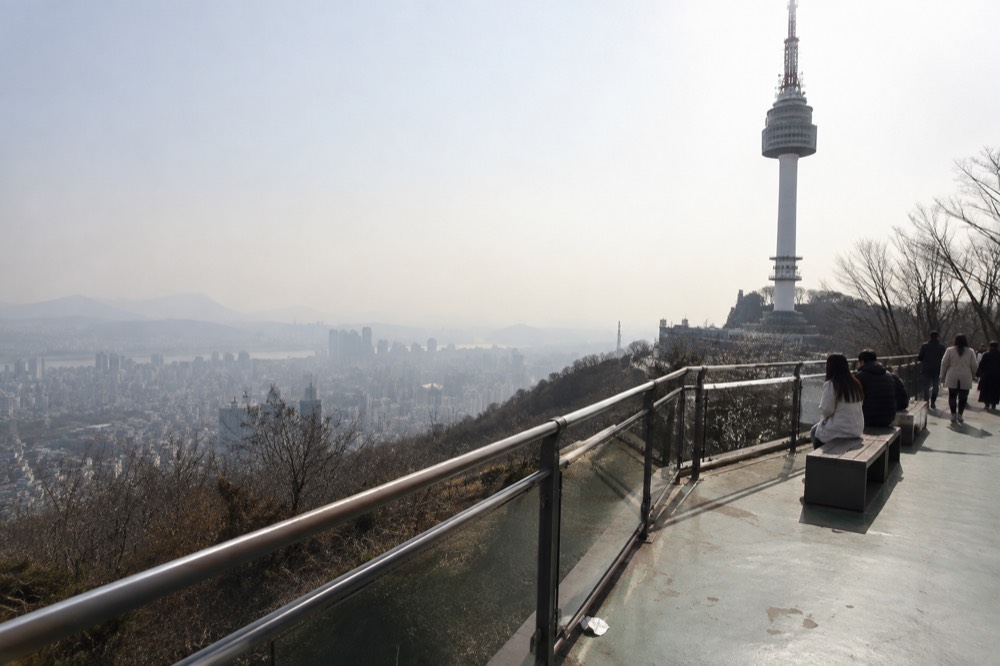
Season is the softest variable. The Seoul Metropolitan Government describes Namsan as a famous cherry blossom spot and names the blossom path from Namsan Public Library up to N Seoul Tower, which makes that southern approach the spring frame. No Namsan-specific bloom date exists, and the Korea Meteorological Administration's figures are Seoul-wide, measured at a standard King cherry tree at the Seoul Weather Observatory: a long-term average of flowering on 8 April and full bloom on 10 April. Treat those as city-wide planning numbers, not a Namsan promise. Autumn foliage dates for Namsan are simply unverified, and this page will not invent them.
Getting up and down shapes the day more than anything else. The cable car costs KRW 15,000 adult round trip or KRW 12,000 one way, the Namsan Ormi inclined elevator is free, running 09:00 to 23:00 with a Monday maintenance suspension from 09:00 to 14:00, and the circular buses 01A and 01B cost KRW 1,500 from Chungmuro or Dongguk University stations. The free shuttle between Myeongdong Station and the cable car platform runs from a first departure at 12:00 to a last at 20:30. A photographer wanting the quiet morning plaza should note that the cable car and the deck both open at 10:00, while the Ormi starts at 09:00 and the buses at 06:30, so the earliest summit light belongs to walkers and bus riders.
| Time | What works | Why |
|---|---|---|
| Early morning | Stairs, summit plaza, beacon mound | Quietest ground, soft light, buses run from 06:30 |
| Midday | Lock terrace close-ups, plaza life, interior deck | Overcast glare on glass, but locks and interiors fine |
| Late afternoon | Sky Forest Trail points, southern approach | City's own sunset-named observatory on the trail |
| Blue hour | Base looking up, lock terrace, Palgakjeong | Tower lit, sky still coloured |
| After dark | Palgakjeong night view, night walk route | City's featured night view, 18:00 and 20:00 walk departures |
Free versus paid: which frames need the ticket?
Only the observatory windows need a ticket, at US$15.25 per adult on the live listing, or KRW 29,000 at the operator's own booth. Every other frame in this guide, the lock terrace, the base, the stairs, the beacon mound, the city wall, the Palgakjeong night view and even the Tower 2F roof terrace, is free ground. The cable car and the circular bus are paid transport to free spots, not paid viewpoints.
This is the boundary worth repeating because so much online copy blurs it. Seoul's official tourism site answers the question directly: the entrance to Namsan Park is free. The operator's FAQ confirms The Place Dining on Tower 2F is usable without an observatory ticket, and YTN Seoul Tower's plaza directory lists a full retail floor open to anyone. A visitor can reach the summit, photograph the tower from the terraces, do the locks, watch the night view from Palgakjeong and ride the free Ormi elevator, all without buying anything beyond transport.
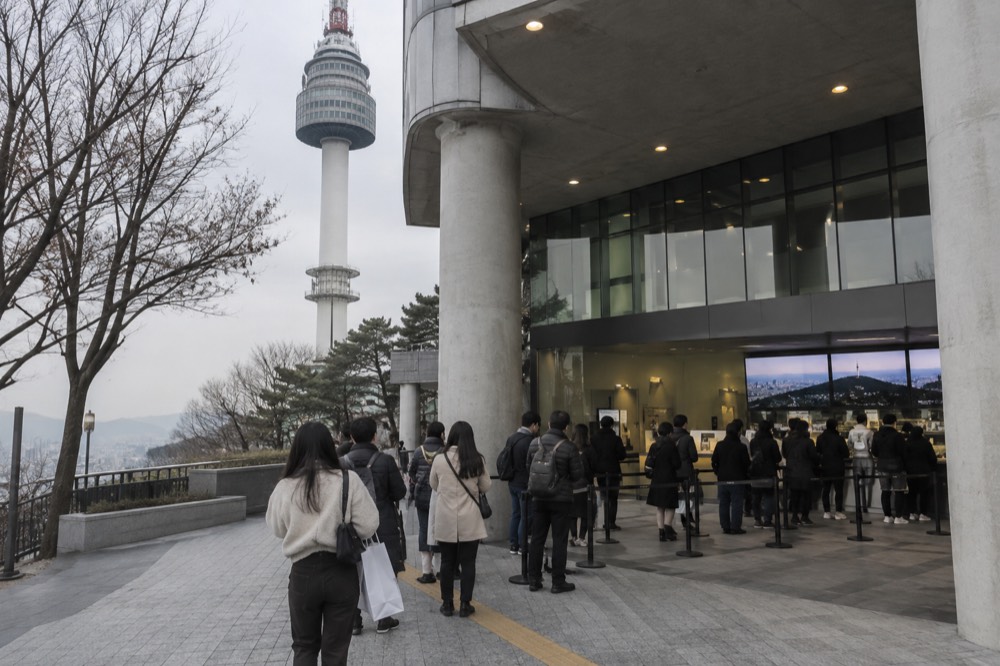
What the ticket buys is narrow and specific: the deck inside the tower, its windows, its telescopes and its post office. The gate prices and the online prices are two separate figures and this site does not compare them numerically; the operator's booth charges KRW 29,000 for adults and KRW 23,000 for children, seniors and kindergarten groups, with under-36-months free, one child per accompanying adult. An advance n.Grill reservation includes free observatory admission, and dining at HanCook earns a discount on it, which makes a restaurant reservation one back door into the window frames.
The fast-track option on the live listing, at US$40.85, is worth a careful sentence. It skips the ticket counter, and that is the whole of the claim; it does not skip the cable car queue, and a buyer of it reported no visible fast-track lane, so nobody should buy it expecting priority entry. The deck-plus-cable-car package at US$28.05 bundles the two, but it requires collecting a physical ticket at a partner shop in Myeongdong first, and collection closes at 18:00, which matters for an evening plan. Whether the included cable car ride is round trip or one way is genuinely unresolved, with reviewers contradicting each other, so this page makes no claim either way. The cable car story in full is in Namsan cable car.
A suggested route for one photography day
A workable one-day route runs: up by bus or stairs in the morning for the quiet plaza and base frames, the lock terrace and beacon mound at midday, the Sky Forest Trail points in late afternoon, the observatory windows through blue hour, and Palgakjeong after dark. The two fixed constraints are the 18:00 Myeongdong pick-up deadline for the package option and the deck's last admission, 30 minutes before its 22:30 or 23:00 close.
The morning half belongs to the free ring. The circular bus from Chungmuro or Dongguk University station, or the stairs for anyone with the legs, puts a photographer on the summit before the cable car's first arrivals. The base-looking-up frames and the empty lock railing are the morning's subjects, and the beacon mound and the city wall path fill any waiting time. The Bongsudae signal station at Palgak Square is a restored Joseon-era structure, Seoul Monument No. 14, and it gives the tower a historic foreground no other spot on the mountain offers.
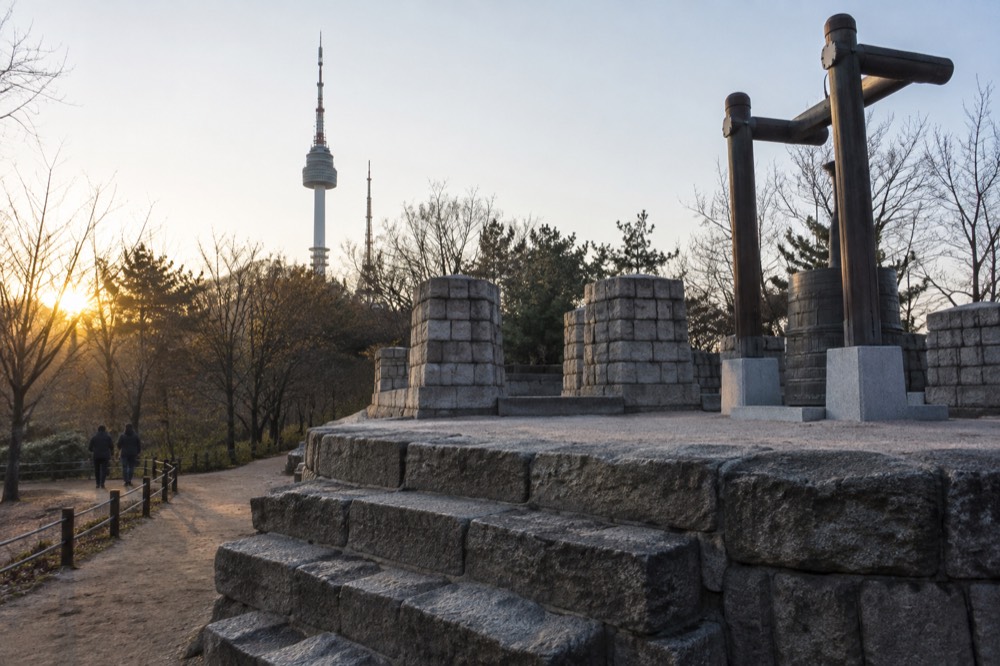
The afternoon rotates to the approaches. The Sky Forest Trail's Sunset Observatory and Wind View Bridge are the city's own named photo points, and the Zelkova Observatory joined them when the night-tour route was published. The blossom path from Namsan Public Library up toward the tower is the spring variant. The evening then splits by ticket: holders go up for the blue-hour windows and come down for Palgakjeong, while everyone else holds the free ring through dark. The night walk's 20:00 departure, ending at Palgakjeong with the city's own suggestion of a descent toward Namdaemun Market for food afterwards, is a ready-made final act.
For anyone weighing the whole question of whether the tower is worth the time at all, the honest case is laid out in is the N Seoul Tower worth visiting, and the timing question, morning against evening, in is it better to go to Namsan Tower at night or morning. The short version for photographers: the free ring rewards the edges of the day, the paid ring rewards blue hour, and the two together make a full day that Namsan Tower Seoul handles well as a single outing.
If the plan now includes the window frames, the transport up or both, these are the three options that cover it.
For a final check before committing, it helps to compare the three side by side. The standard ticket covers the deck alone, the fast-track version covers the same deck with the counter skipped, and the package adds the cable car ride with its Myeongdong pick-up step. Whichever way the day is built, the free ring stays free, so the ticket decision only ever concerns the interior frames and the ride up.
Common questions about N Seoul Tower photos
Do you need a ticket to take photos at N Seoul Tower?
No. The summit plaza, the lock terrace, the terraces around the tower base, the stairs, the beacon mound, the city wall path and the Palgakjeong night view are all free. Only the observatory deck inside the tower needs a ticket, at US$15.25 per adult on the live listing or KRW 29,000 at the operator's booth.
Where is the best free photo spot at N Seoul Tower?
The lock terrace between the tower and Palgakjeong is the most photographed free spot, and the city's own guided night walk routes past it. The tower base looking straight up and the Palgakjeong night view are the other two strong free frames.
Can you photograph the love locks?
Yes. The locks are present, active and part of what Seoul itself promotes on Namsan, and the city's night walk passes the love lock deck by name. Visitors report buying and engraving padlocks on site. Nothing verified exists about their exact level, count or any removal programme, so no source-backed detail beyond that is available.
What time does the tower light up for photos?
The tower is lit after dark, but no operator or city source publishes a switch-on time. The switch-on times in third-party guides are unsourced. The fixed evening facts are the observatory's closing time, 22:30 weekdays and 23:00 weekends and public holidays with last admission 30 minutes earlier, and the city night walk's 18:00 and 20:00 departures.
Is the observatory good for photos?
Yes, for skyline-through-glass frames. The operator states clear-day visibility up to 50 km, and the digital telescopes offer optical zoom up to 36x. Shoot close to the pane to beat reflections and prefer blue hour. The Tower 2F roof terrace is the one interior-adjacent frame that needs no ticket.
How long should a photography visit take?
The free ring alone fills a half day at a relaxed pace, and a full day covers the stairs or trail, the summit spots, the observatory and the night view. The deck's last admission, 30 minutes before closing, and the 18:00 Myeongdong pick-up deadline for the package option are the two times that constrain an evening plan.