Namsan Tower on Screen: KPop Demon Hunters and Every Real Location
Netflix's biggest animated hit staged its climax on Namsan, and the tower's screen life goes back decades. Here is what is real, what is drawn, and where to stand.
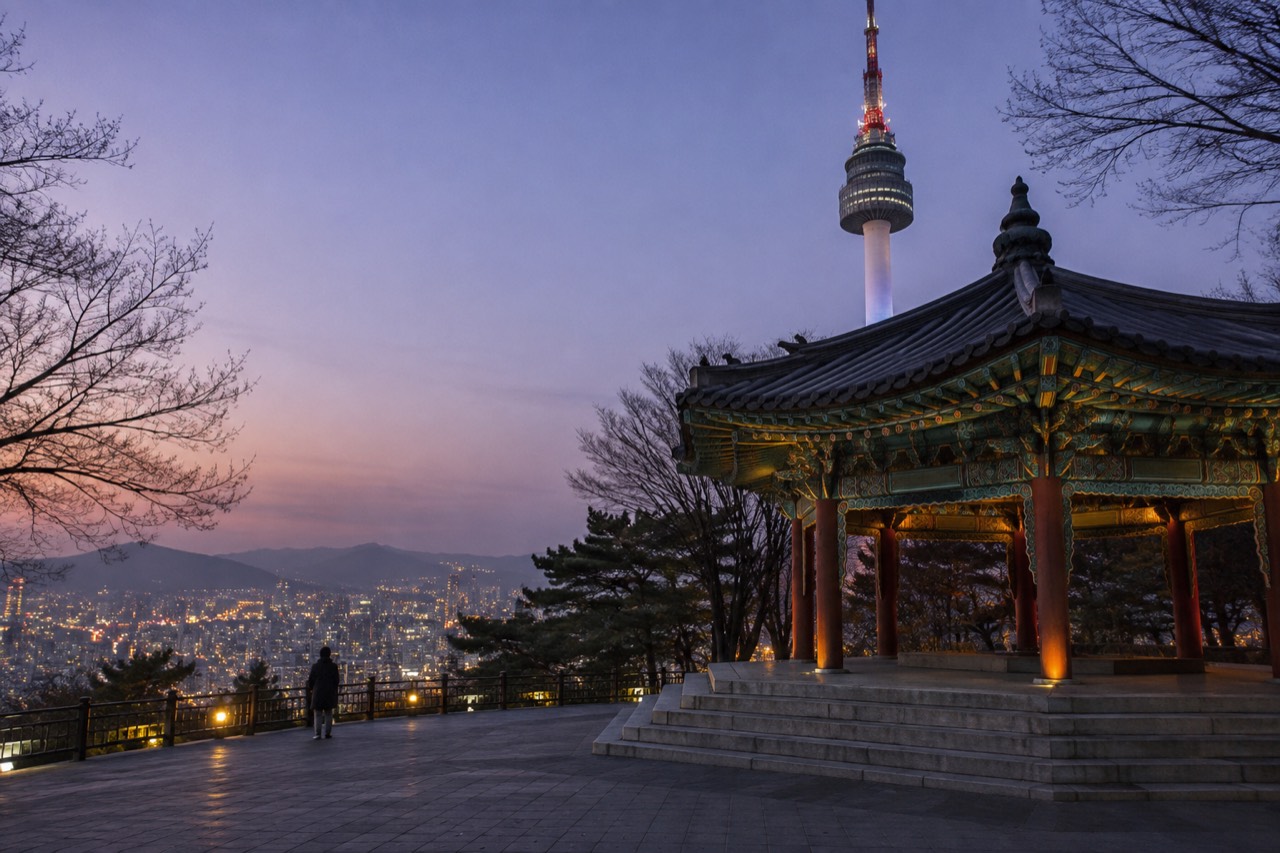
Short answer
N Seoul Tower appears in KPop Demon Hunters, released 20 June 2025, as the site of the film's climax: a fictional stadium beneath the tower where the Saja Boys perform. The stadium is animation, but the tower, the cable car and the love locks are real and free to visit. The observatory deck is the only ticketed part.
N Seoul Tower spent fifty years as a broadcast mast before it became a film location, and the two careers are connected. The tower is a working transmitter, which is exactly why the animators of KPop Demon Hunters wanted it: a beacon at the heart of the city, sending something out to everyone below. The film, released on Netflix on 20 June 2025, staged its climax on the hill of Namsan, and in the months after, visitors began retracing the trail through Seoul in numbers the mountain had not seen before. This guide separates the real locations from the drawn ones, names the productions that are actually verified, and tells you where to stand for the shot.
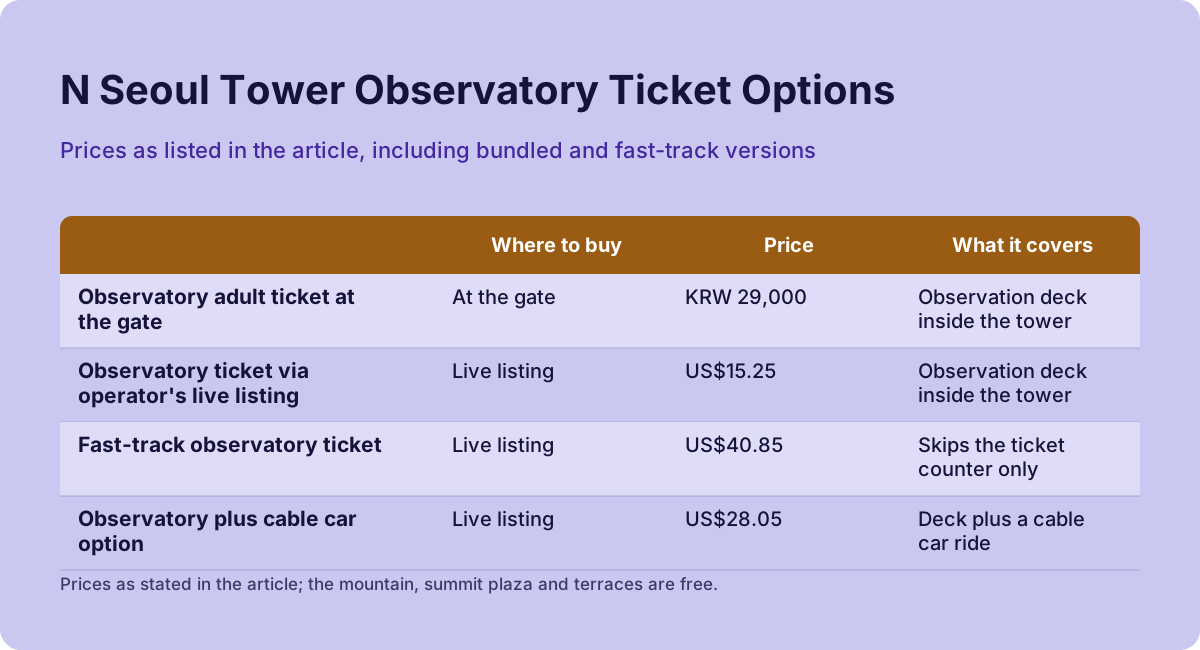
One thing to settle at the start, because it shapes everything else on this page: the mountain is free and the deck is not. Namsan Park, the summit plaza, the terraces around the tower base, the love locks and the trails are all open without a ticket. Only the observation deck inside the tower is paid, at KRW 29,000 for an adult at the gate or from US$15.25 through the operator's live listing. A screen-location pilgrimage can therefore cost nothing at all, or include the deck view, and both are legitimate versions of the same trip.
Which productions actually used N Seoul Tower?
The verified on-screen appearances are narrower than the internet suggests. KPop Demon Hunters is the confirmed headline: Netflix's own locations guide gives the tower its own section and describes the climax staged beneath it. Beyond that, the one drama connection with a source is the Sam-soon Steps, which the tower operator itself attaches to "My Lovely Sam-soon". Other drama filming claims circulate but could not be verified.
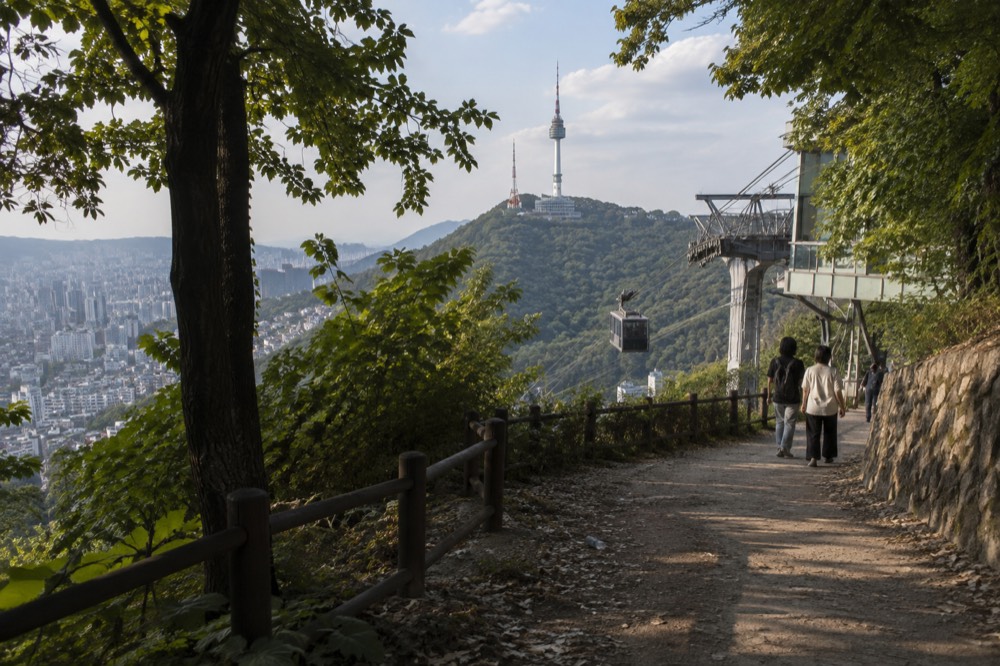
Netflix's own Tudum locations guide for KPop Demon Hunters is the primary source here, and it is unusually specific. It describes the demon ruler Gwi-Ma drawing a crowd to a fictional stadium set underneath N Seoul Tower, where the Saja Boys perform "Your Idol". Writer-director Chris Appelhans is quoted directly on the page: "The Saja Boys concert is staged on the hill of Namsan Tower, a beacon at the heart of the city, summoning everybody." The same page notes the real tower is a working broadcast and communications tower, which is why the story uses it as a transmitter of something else.
That last detail matters for anyone writing or posting about the film. The animators did not pick the tower for its view. They picked it because it is Seoul's most visible piece of broadcast infrastructure, a mast the whole city can see, and they turned that function into the plot: the tower as an antenna for a signal nobody should be receiving. The film also draws on other real Seoul locations, including Naksan Park for its "Free" sequence and Bukchon, and the Korea Times ran a feature retracing that trail, headed at N Seoul Tower under the heading "Battlefield reimagined" (read the piece).
The drama history is real but smaller than fan pages claim. The tower operator itself connects the Sam-soon Steps, beside the Seoul Education Research and Information Institute, to the drama "My Lovely Sam-soon", and gives the climb up to Palgakjeong as 40 minutes. That is the one drama association with an operator source behind it. Lists of other famous Korean dramas said to have filmed at the tower circulate online, but none of them could be confirmed by a second independent source, so this site does not repeat them. If a blog names four dramas at the tower, treat it as a claim, not a fact.
| Production | Tower connection | What is verified | What is animation or unverified |
|---|---|---|---|
| KPop Demon Hunters (2025) | Climax staged on Namsan, beneath the tower | Netflix's own locations guide; director quote; Korea Times feature on the real-world trail | The stadium beneath the tower is a fictional set |
| My Lovely Sam-soon (drama) | The Sam-soon Steps are named for it | The tower operator attaches the drama to the steps | Nothing about the tower interior is claimed |
| Other named dramas | Various filming claims | None confirmed by two sources | Do not rely on fan-site lists |
Is the KPop Demon Hunters concert scene a real place?
No. The stadium where the Saja Boys perform "Your Idol" does not exist. Netflix's guide describes it as a fictional stadium set underneath N Seoul Tower, drawn for the film. The tower above it is real, the hillside is real, and the crowd scenes borrow the feel of the real summit plaza, but there is no venue on Namsan and never has been.
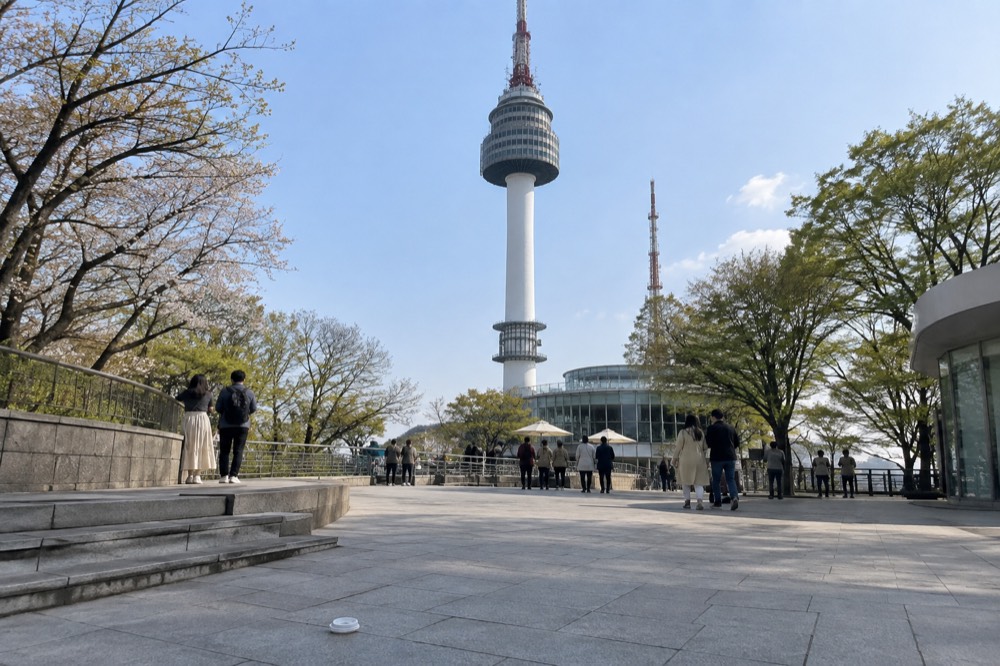
This is the distinction the whole pilgrimage hangs on. Visitors arriving after the film sometimes ask where the stadium is, and the honest answer is that the animators built it digitally on the slope. What they used faithfully was everything around it: the tower's silhouette, the wooded hill, the sense of the city pressing in on all sides. The real summit is an open plaza with terraces, cafes, the love lock deck and the Palgakjeong pavilion area, and none of it is a performance venue.
What the real summit does have is atmosphere the film captures well. Evening on Namsan is when the tower lights up, and the cable car company itself names sunset to night view as its recommended riding time. Visitors retracing the film in the evening will find the plaza busy, because evenings, weekends and holidays are the crowded windows at both the tower and the cable car, while weekday visits and the early or late ends of the day are quieter. That is qualitative, from visitor reports and the operators' own advice; nobody official publishes a wait in clock terms.
For the deck view the film draws from, the observatory ticket is the paid product, and it comes in several options through the operator's live listing.
The basic observatory ticket, from US$15.25, covers the observation deck inside the tower. A fast-track version exists at US$40.85, though one buyer reported no visible fast-track lane, so treat the name cautiously: what any prebooked ticket reliably skips is the ticket counter, not a queue. The combined observatory-plus-cable-car option at US$28.05 bundles a cable car ride, and note its quirk: a physical ticket must be collected at a partner shop in Myeongdong first, and collection closes at 18:00.
Where do you stand for the KPop Demon Hunters shot?
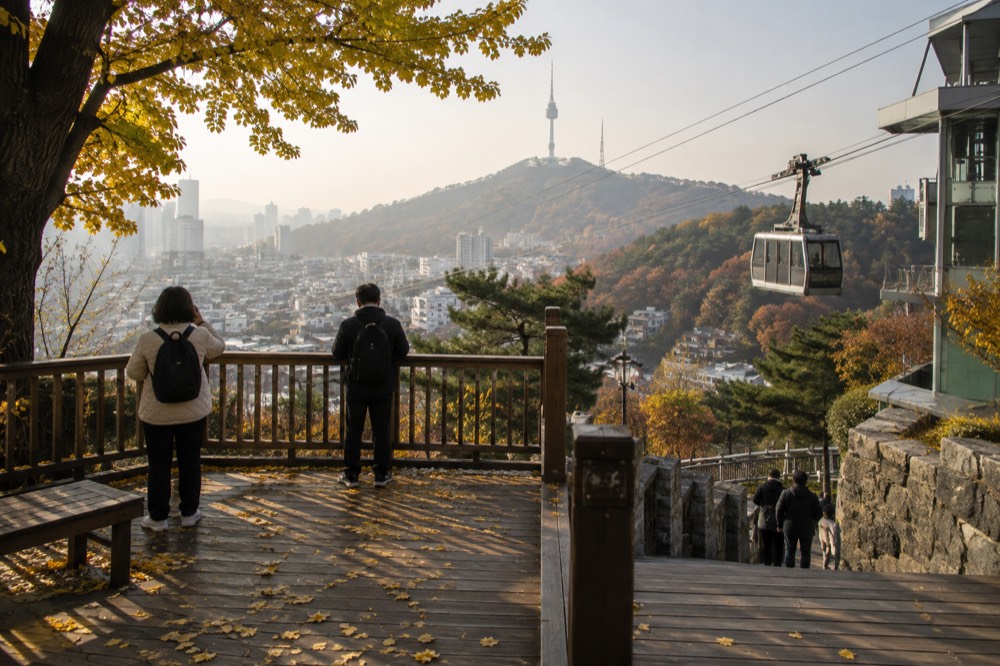
The tower's own summit plaza is the answer for the wide shot: stand on the terraces around the tower base and you have the angle the film uses, with the mast rising above you and the city below. For the classic full-tower silhouette, the spots are the Namsan trails and viewpoints around the mountain, including the Zelkova Observatory and Sunset Observatory on the new Sky Forest Trail. All of them are free.
The film's framing puts the tower on a hill above a crowd, and the real summit plaza gives you exactly that relationship: you, a crowd of visitors, and the mast overhead. The terraces around the base, the area near the love lock deck and the ground around Palgakjeong all work. None of it needs a ticket, which surprises visitors who assume the whole summit is behind the gate. The ticket booths sit at Plaza 5F and Tower 1F, and everything outside that gate, every shop, cafe and terrace, is open to anyone.
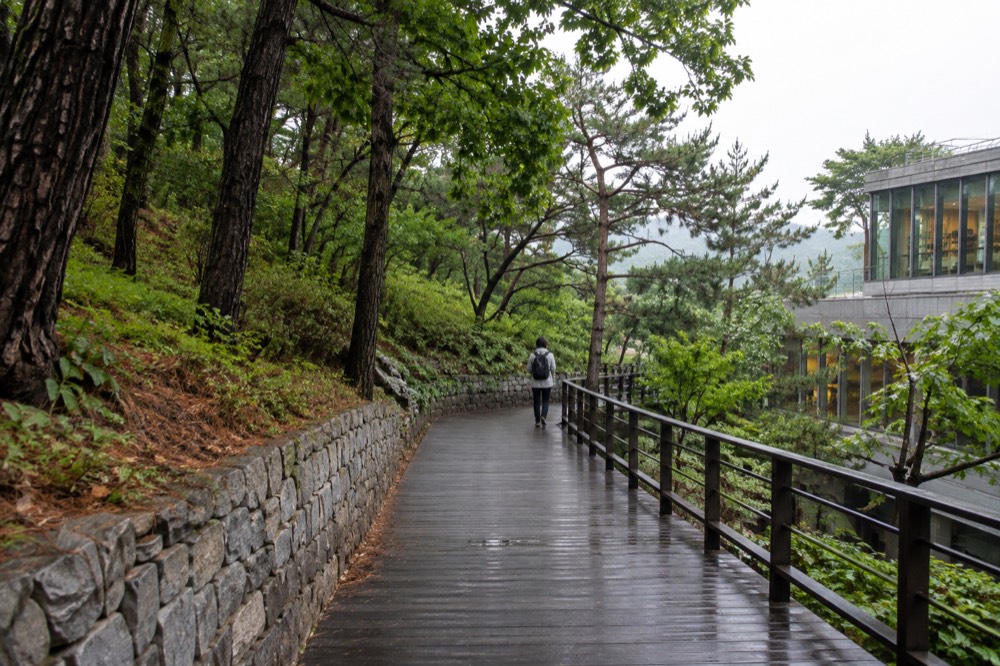
For the silhouette shot, the mountain itself is the camera position, and Namsan gained a genuinely new set of them in late 2025. The Seoul Metropolitan Government opened the Namsan Sky Forest Trail on 25 October 2025, a barrier-free timber deck path built with the Korea Forest Service so wheelchair users and older visitors can get up the mountain (see the report on the trail's opening). Its named stops include the Sunset Observatory, a glass-fenced sky-view photo point, the Wind View Bridge over a metasequoia stand, and the Zelkova Observatory. As part of the same works the city closed the unofficial side paths that had been worn into the mountain and restored them, so freestyle routes up no longer exist: use the official trails.
| Shot you want | Where to stand | Cost |
|---|---|---|
| Tower overhead, crowd below (film's framing) | Summit plaza terraces around the tower base | Free |
| Love lock deck with the tower behind | The lock terraces between the tower and Palgakjeong | Free |
| Full tower silhouette from a distance | Zelkova Observatory or Sunset Observatory on the Sky Forest Trail | Free |
| City panorama with the tower in frame | The deck inside the tower, Tower 4F and 5F | Observatory ticket |
| Night tower lit above the skyline | The Seoul City Wall path or the lower Namsan viewpoints | Free |
One more summit option belongs on this list because it is days old. From September 2026, Seoul's free guided walking-tour programme added a Namsan City Wall night course, running every day with departures at 18:00 and 20:00, led by a licensed city guide. The route passes N Seoul Tower and the love lock deck by name and finishes at Palgakjeong, deliberately linked to a descent toward Namdaemun Market. It is booked in advance through the city's own walking-tour site at dobo.visitseoul.net, and it is free (read the city's announcement). For a film pilgrimage, a guided evening walk past the tower is about as good as the free side of Namsan gets.
The deck itself, if you decide the interior view is worth the ticket, is the one part of the pilgrimage that costs money. It is also the only part of the tower the film's audience can enter: the rotating n.Grill on Tower 7F, the digital telescopes with 36x zoom on the observation floors, and the Sky Post Office, where postcards bought at the observatory's gift shop are mailed with domestic delivery in 2 to 3 days and overseas in about 15.
Did KPop Demon Hunters change Namsan itself?
Yes, measurably, and a named official said so. Seoul's mayor, Oh Se-hoon, visiting Namsan to inspect access improvements, publicly tied the mountain's visitor surge to the film: "With its recent appearance in K-Pop Demon Hunters, even more domestic and international tourists are expected to visit." The city's trail-building programme, including the Sky Forest Trail, was framed as part of the response.
This is a rare case where a screen effect can be traced to a primary source rather than travel-blog inference. The mayor's visit and quote were reported in October 2025, in the same coverage that documented the Sky Forest Trail's opening, and the Korea Tourism Organization promoted the film's real Seoul locations, the tower among them, through its own VisitKorea channels. The film's reach even extended into city programming: Seoul's 2025 Han River Light Performance drone show at Ttukseom Hangang Park was themed on KPop Demon Hunters, running through September and October 2025. Note carefully that the drone show happened at the Han River, not at Namsan, and it has finished, so do not plan around it.
What the film did not change is the mountain's free-versus-paid boundary. Nothing on Namsan moved from free to paid or paid to free in the last twelve months. The park, the trails, the summit plaza, the love locks, the Ormi inclined elevator and the cable car company's Myeongdong shuttle bus all remain free; the deck ticket, the cable car ride if you take it, the circular bus fare, parking, food and shopping remain the costs. The new night walk only widened the free side.
For visitors who want the interior deck after walking the free exterior, the observatory ticket is the one bookable product on this mountain, and the standard option is the simplest version of it.
What does the film get right and wrong about the tower?
The film gets the tower's role as a transmitter right, its silhouette right and its hillside setting right. It invents the stadium, and it compresses the geography: the real summit is a plaza with a pavilion, terraces and a beacon mound, not a concert slope. The tower's real specifications are on the operator's own pages: a 236.7 m structure on a 270 m mountain, 506.7 m above sea level in total.
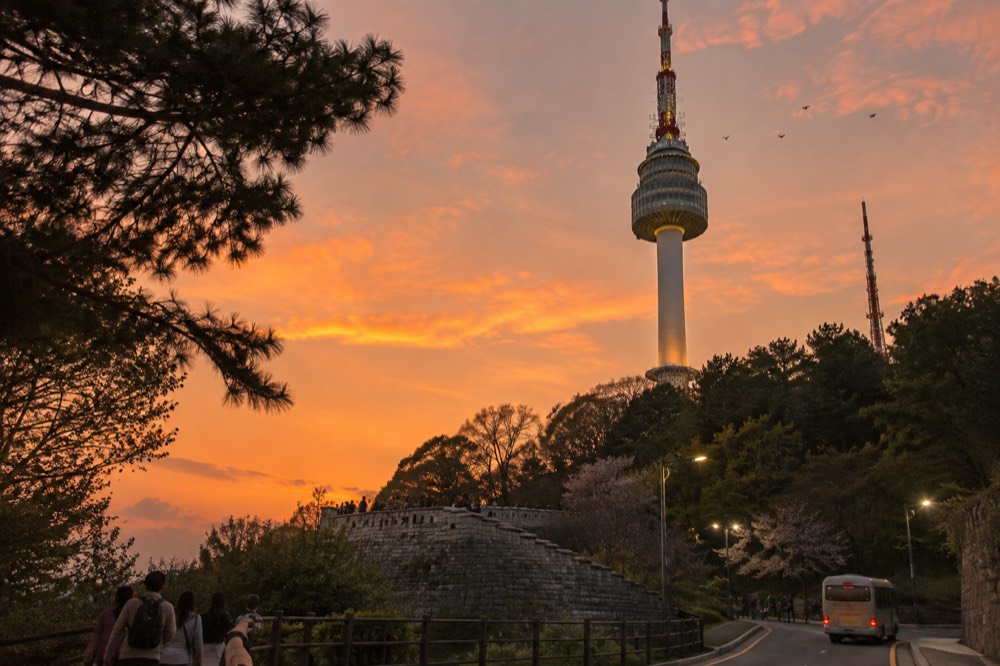
The transmitter detail is the film's best piece of research. N Seoul Tower began life as a broadcast facility: MBC-TV transmission started in April 1972, KBS-TV in August 1972, SBS in November 1991, and the mast still does that work. Netflix's own locations page points this out, and it is why the story's use of the tower as an antenna for something else lands. The observatory came later, completed in July 1975 and opened to the public in October 1980.
The numbers worth knowing, all from the operator's specification pages: the tower structure stands 236.7 m, made up of a 135.7 m body and a 101 m steel mast, on Namsan at 270 m, for a total elevation of 506.7 m above sea level. Be wary of a second figure in circulation, 479 m, which is the cable car company's own marketing number; use the operator's. The tower is rated safe in winds up to 56 m per second, and the rotating restaurant on Tower 7F completes one full rotation in 1 hour 40 minutes.
| Element in the film | Real counterpart | Verdict |
|---|---|---|
| Tower as a broadcast antenna | Real: TV transmission since 1972 | Accurate |
| A stadium beneath the tower | Nothing on Namsan matches it | Invented |
| The tower on a wooded hill above the city | Namsan, a civic park in four districts | Accurate |
| Crowds gathered on the slope | The summit plaza and terraces, busy in evenings | Close to real |
| The tower lit at night | Real: lit after dark, with lighting used for one-off commemorative light-ups | Accurate |
One caution on the lighting. The tower's exterior lighting changes, and since January 2011 the tower body's lighting colour has signalled Seoul's fine-dust level; the tower is also used for one-off commemorative and diplomatic light-ups, such as the sixtieth-anniversary lighting staged by the Korean and Japanese foreign ministries. But no operator or city source publishes a switch-on time, and the colour code behind the air-quality signalling is not verified, so any page giving you exact lighting times is repeating other blogs, not the tower.
Can you film at the tower yourself?
Yes, but permission must be arranged at least 3 working days ahead, per the operator's own FAQ. Casual photos and phone video need nothing: the summit plaza, the terraces and the trails are open ground, and visitors shoot there constantly. Formal filming, drones and commercial shoots are a different matter, and the rules on tripods and drones are not published in verified form, so ask the operator directly before planning equipment.
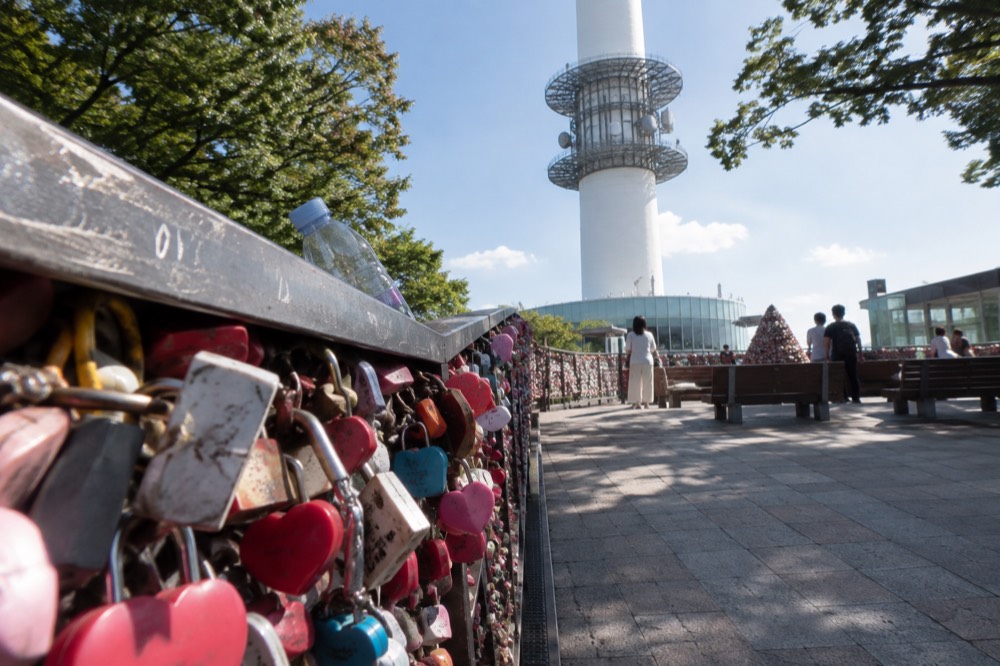
For a film-location video or a photo essay, the practical route is the free one. The summit plaza and the terraces around the tower base give you the film's framing without a ticket. The love lock deck, the Palgakjeong area and the Bongsudae beacon mound, a restored Joseon-era signal station designated Seoul Monument No. 14, are all in the free zone. The Seoul City Wall trail from Sungnyemun to Jangchung Gymnasium, Historic Site No. 10, runs on the mountain too. If your shoot wants the interior, the observatory ticket covers the deck, and the digital telescopes on Tower 4F and 5F zoom to 36x.
Getting up with gear is easiest via the cable car or the Namsan Ormi. The cable car runs 10:00 to 23:00 every day, with adult fares of KRW 15,000 round trip or KRW 12,000 one way, and the last ticket is sold 30 minutes before closing. The Ormi, a free glass-walled inclined elevator between Namsan Tunnel 3 and the cable car station, runs 09:00 to 23:00, suspended every Monday from 09:00 to 14:00 for maintenance and also in strong wind or heavy rain. Our guide to the cable car and its fares covers the choices in full, and the full getting-there guide lists every bus, trail and station option.
For anyone pairing the pilgrimage with the ride up, the combined observatory-plus-cable-car option bundles the two, with the Myeongdong pick-up quirk noted earlier.
How do you plan a screen-location day on Namsan?
Start from Myeongdong, ride or walk up in the late afternoon, shoot the summit plaza and the love lock deck in the evening light, and let the deck ticket decide itself. The observatory runs 10:00 to 22:30 on weekdays and 10:00 to 23:00 on weekends and holidays, with last admission 30 minutes before closing, so an evening visit fits any version of the day. Weekdays are the quieter choice.
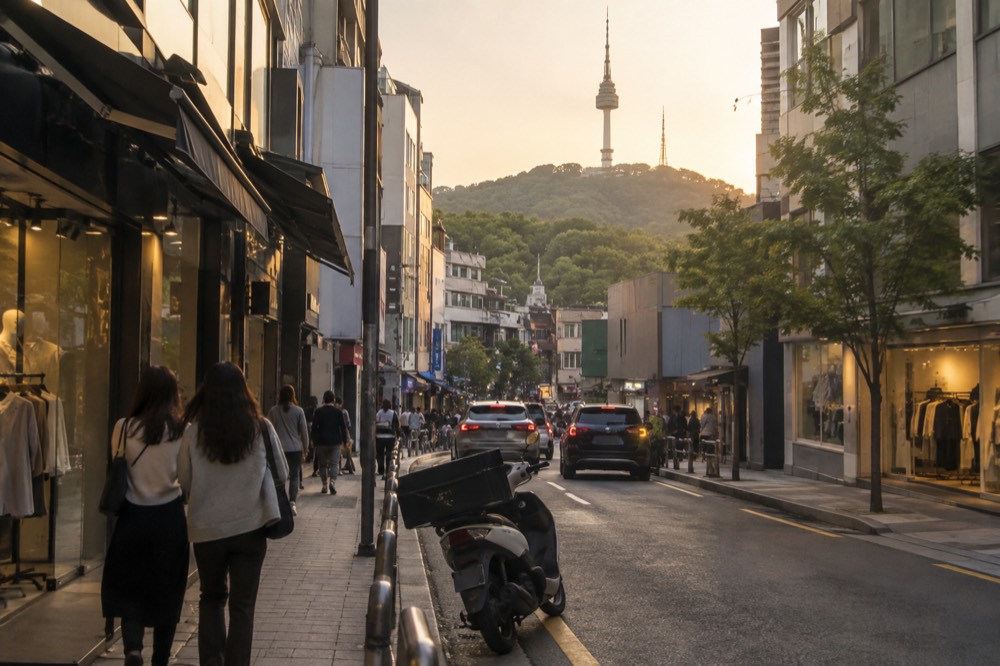
The geography rewards a Myeongdong start. The cable car base station is up the hill from Myeongdong, not beside it: the tower operator directs visitors from Myeongdong Station Line 4 Exit 3 along the street on the right of the Pacific Hotel, about 10 to 15 minutes on foot, while the cable car company pairs Exit 3 with walking and Exit 4 with the Namsan Ormi, turning left at Hoehyeon intersection to the boarding point near the Namsan Tunnel 3 commemorative monument. The city's own sourced walks are 590 m, about 12 minutes, from Myeong-dong Station Exit 4 via Namsan Tunnel 3, and 790 m, about 15 minutes, from Hoehyeon Station Exit 1 through the underground shopping centre to the Ormi. The cable car company also runs a free shuttle between Myeongdong Station and the cable car platform, first departure 12:00 and last 20:30.
The circular buses are the other spine: routes 01A and 01B board at Chungmuro Station or Dongguk University Station, stop at N Seoul Tower, cost KRW 1,500, and run 06:30 to 23:00, with 01A every 9 minutes and 01B every 14. Private cars cannot drive up at all: general vehicle access has been restricted since 1 May 2005, and tour-bus access to the circular road since August 2021.
| Part of the day | What to do | Cost |
|---|---|---|
| Afternoon | Myeongdong, then cable car, Ormi, bus or a trail up | KRW 15,000 round trip by cable car, or KRW 1,500 by bus, or free on foot |
| Early evening | Summit plaza, terraces, love lock deck, Palgakjeong area | Free |
| After dark | The lit tower from the plaza, or the deck for the city panorama | Deck ticket, from US$15.25 online |
| Late | Descend by cable car or bus, or join the city's free 20:00 night walk finish | Free |
Food needs a note, because the operator's rules are specific. You cannot eat your own food inside N Seoul Tower; the FAQ directs visitors with packed meals to the plaza in front of Palgakjeong, which works well for a picnic-style evening. The paid options inside and around the base include n.Grill, HanCook, The Place Dining, which is reachable without an observatory ticket, and the Seoul Tower Plaza floors below, where Starbucks, GS25, bhc Chicken and others are open to anyone. N Burger reopened in 2026 as a K-style handmade burger house with a Seoul bulgogi burger on the menu, and N Terrace reopened after its own short renewal in the same March 2026 works.
If the plan firms up around the interior view, the fast-track version of the ticket exists at US$40.85, with the caveat already noted: one buyer reported no visible fast-track lane, so buy it for what it is, a prebooked observatory ticket, not a queue guarantee.
What else should a film pilgrim know?
The love locks are active and city-promoted, the Sam-soon Steps give you the one verified drama location, and the whole area is non-smoking under the National Parks Act, with a stated fine of KRW 100,000. Pets split by operator: the tower itself does not admit them, while the shared plaza area allows leashed pets subject to each store's rules. Tickets are same-day only at the gate.
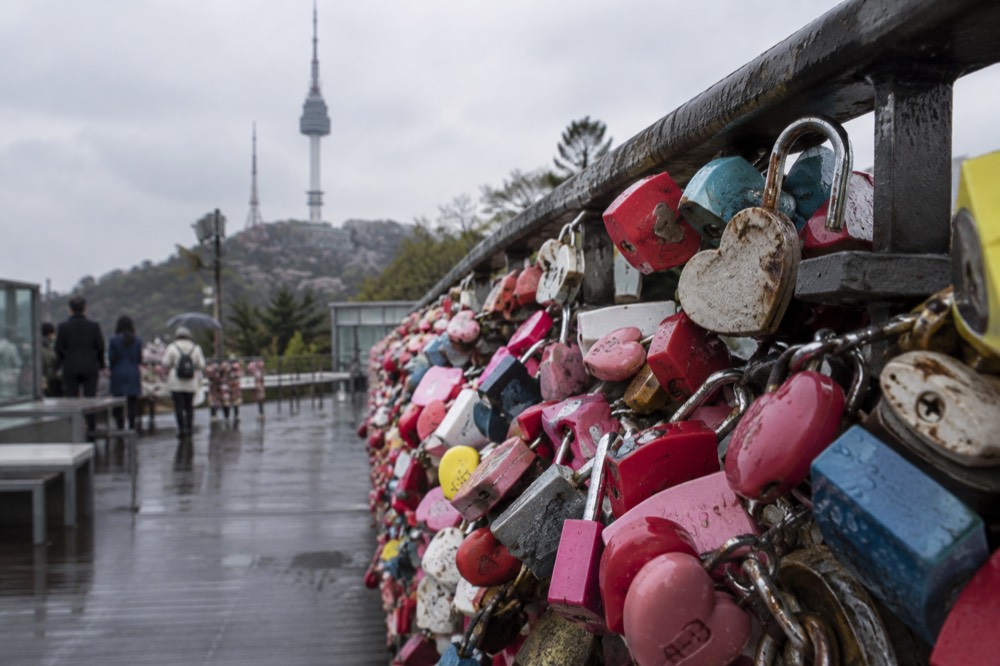
The locks deserve their own paragraph because the film brought new attention to them and because a debunked social-media story claimed they had been cut down. The verified position: the locks are still active, Seoul's own new night walk routes walkers past the love lock deck by name, the city's visitor page for the tower still lists the Locks of Love among its attractions, and visitors in 2026 report buying locks on site, including branded locks engraved there. No operator, city or news source announces any removal programme, and no source says the locks are cleared on a cycle. That is the honest answer, and it is the one to repeat. Our longer piece on the love locks and their current state goes deeper.
The Sam-soon Steps are the quiet second location. They run beside the Seoul Education Research and Information Institute up to Palgakjeong, the tower operator gives the climb as 40 minutes, and the operator itself is the source connecting them to "My Lovely Sam-soon". It is the only drama association on this mountain with a primary source behind it, which makes it the counterweight to the unverifiable drama lists online.
A few practicalities close the plan. Wheelchairs and strollers can be borrowed at the information desk, on 02-3455-9277 or 9288. The observatory is open 365 days a year. On a clear day the operator states you can see up to 50 km from the deck, naming Bukhansan to the north and Gwanaksan to the south among the landmarks. And the tower's address, for any filming permission request or navigation app, is 105 Namsangongwon-gil, Yongsan-gu, Seoul 04340. This site, Namsan Tower Seoul, keeps the full ticket, transport and hours picture in one place if the day grows beyond the film trail.
For the evening version of the pilgrimage, the free city night walk is worth booking ahead through the city's own site, and the tower at night guide covers the lighting, the late hours and the quiet windows in detail.
Common questions about N Seoul Tower on screen
Was N Seoul Tower actually in KPop Demon Hunters?
Yes. Netflix's own locations guide gives the tower its own section and describes the climax, a fictional stadium set underneath N Seoul Tower where the Saja Boys perform. Writer-director Chris Appelhans is quoted on the page confirming the staging on the hill of Namsan Tower.
Is the stadium in KPop Demon Hunters a real place?
No. It is a fictional stadium set drawn beneath the real tower. There is no performance venue on Namsan; the real summit is an open plaza with terraces, cafes, the love lock deck and the Palgakjeong pavilion area.
Where do you stand for the KPop Demon Hunters shot?
The summit plaza terraces around the tower base give the film's framing, tower overhead and city below, for free. For the full silhouette, the Zelkova Observatory and Sunset Observatory on the Sky Forest Trail, opened 25 October 2025, are the newer free viewpoints.
Which dramas filmed at N Seoul Tower?
The only drama connection with a verified source is the Sam-soon Steps, which the tower operator itself attaches to "My Lovely Sam-soon". Other drama filming claims circulate online but none could be confirmed by a second independent source.
Do you need a ticket to visit the KPop Demon Hunters locations?
No. Namsan Park, the summit plaza, the terraces, the love lock deck and the trails are all free. Only the observation deck inside the tower is ticketed, from US$15.25 online or KRW 29,000 for an adult at the gate.
Can you film at N Seoul Tower?
Casual photos and phone video need no permission. Formal filming must be arranged with the operator at least 3 working days ahead, per its FAQ. Tripod and drone rules are not published in verified form, so ask the operator before bringing equipment.