Why Is Seoul Tower So Famous?
The story of how a broadcast mast on Namsan, completed in 1971, became Seoul's most recognisable landmark: the build, the 1980 public opening, the dramas, the love locks and the observatory ticket.
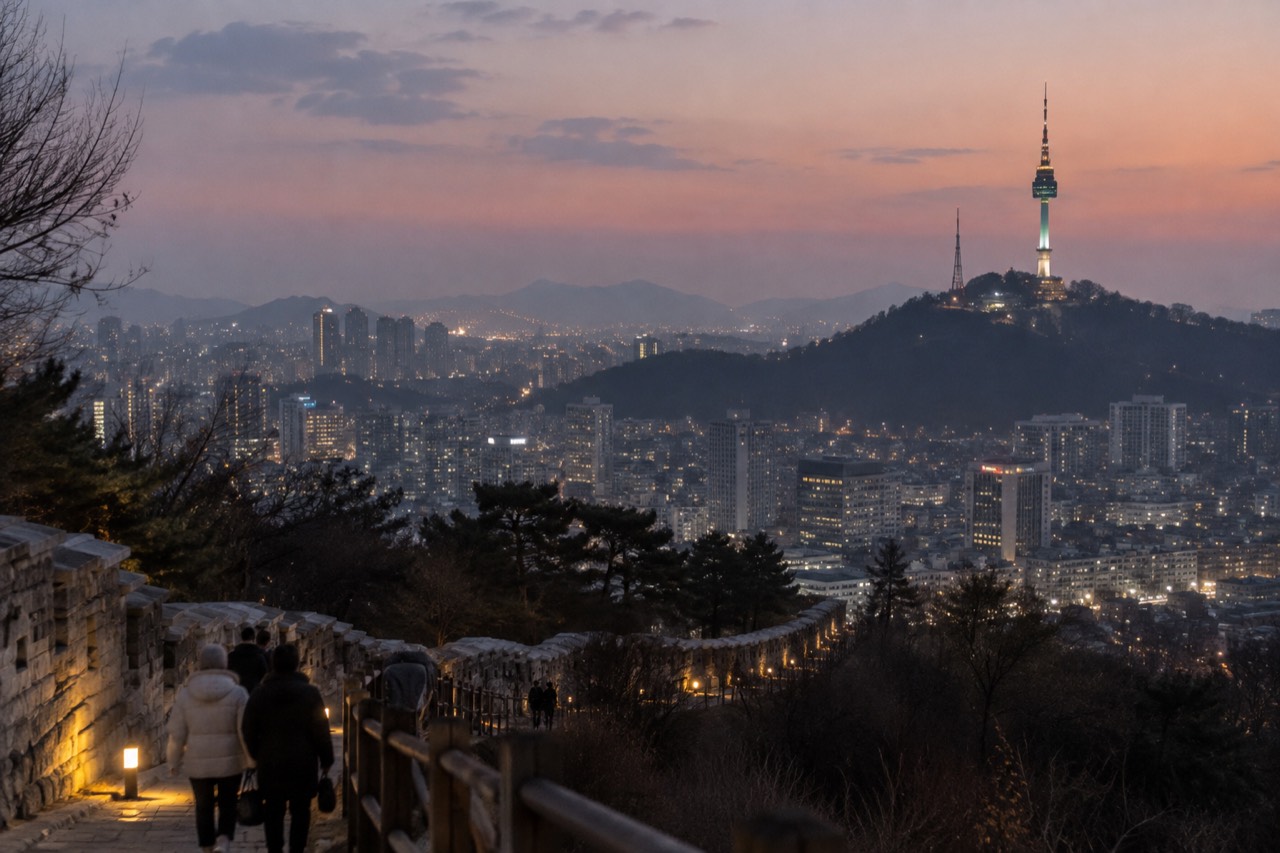
Seoul has palaces older than most countries and a skyline crowded with glass, yet the building people photograph first is a concrete and steel mast on a small mountain in the middle of the city. It was not designed to be loved. It was designed in the late 1960s to fix a broadcasting problem, and almost everything that made it famous arrived later, piece by piece, over five decades. The observatory came in 1980. The dramas came in the 2000s. The padlocks, the lighting, the Netflix film, the free city night walks over the summit: each one added a layer, and the layers stuck.
This is the story of how that happened, drawn from the operator's own notices, the city's announcements and what visitors themselves report about the tower that circulates online.
Why Is Seoul Tower So Famous?
Seoul Tower is famous because it is the one structure visible from almost everywhere in the city, standing 236.7 m tall on Namsan mountain, which itself rises 270 m above sea level. Built as a television and radio mast and opened to the public as an observatory in October 1980, it later absorbed the Korean Wave, the love-lock ritual and the city's own air-quality lighting to become the landmark Seoul is known by.
The fame is really three different kinds of fame stacked on top of each other. The first is geographic: Namsan sits at the centre of Seoul, and the tower stands on its summit, so the structure reads as the city's fixed point from nearly every neighbourhood. The second is cultural: from the early 2000s, Korean dramas and films used the tower as a backdrop so consistently that audiences abroad learned to recognise it before they could name a single Seoul district. The third is participatory: people do not just look at the tower, they attach padlocks to it, ride a cable car to it, walk up to it at night and send postcards from it.
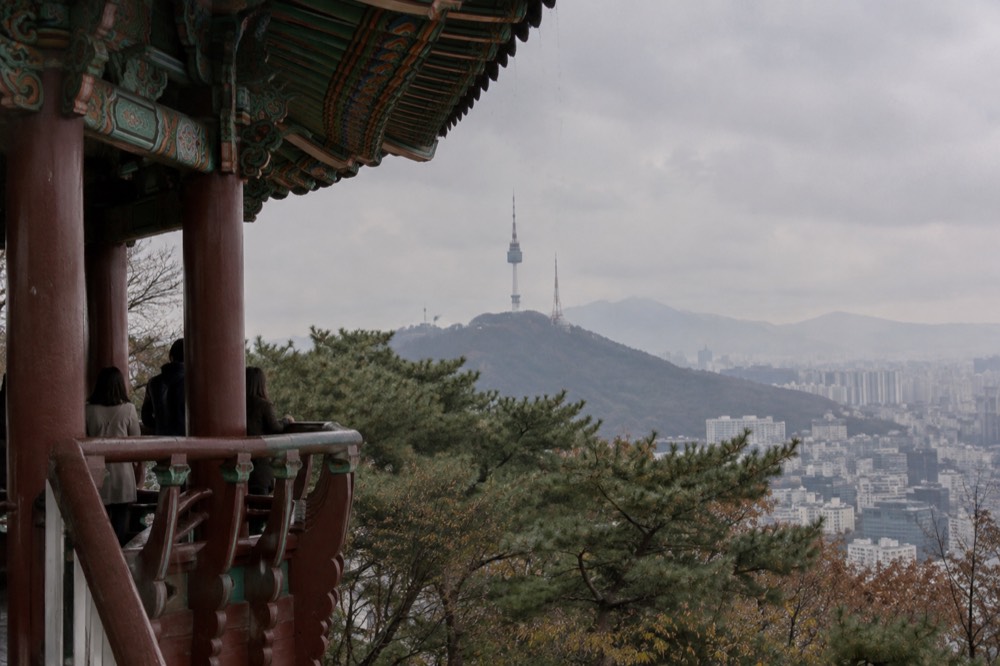
Each of those layers is traceable to a real decision or a real event, which is what makes the story worth telling properly. The operator's own history pages record the construction timeline in detail, and the tower's official history page is the primary source for most of what follows.
If you want the short version of how to experience the famous part yourself, these are the three most common ways visitors do it:
A television mast that became a public observatory
The tower was built between 1969 and 1975 as a broadcast facility, with the steel mast finished in October 1971 and television transmission beginning in 1972. The observatory was completed in July 1975, but the public opening only came in October 1980, and that delay is exactly why the tower became a destination rather than infrastructure.
The origin story is unglamorous. Seoul's television signals in the late 1960s were weak and uneven, and the solution was a tall transmitter on the city's central mountain. The steel mast went up first, in October 1971, and the antenna installations followed in November. MBC-TV began transmitting from the site in April 1972 and KBS-TV in August of the same year. SBS joined in November 1991. In other words, for its first decade the tower was a working utility, and the observatory floors were finished in 1975 but kept closed to the public for another five years.
The October 1980 opening changed the building's relationship with the city. Once anyone could buy a ticket and ride up, the tower stopped being something Seoul looked at and became something Seoul visited. The operator's own records mark the 10 millionth observatory visitor in May 1990 and the 20 millionth in April 2001, which gives a sense of the steady accumulation behind the fame. The tower joined the World Federation of Great Towers in February 1989, putting it in the same club as the world's best-known towers.
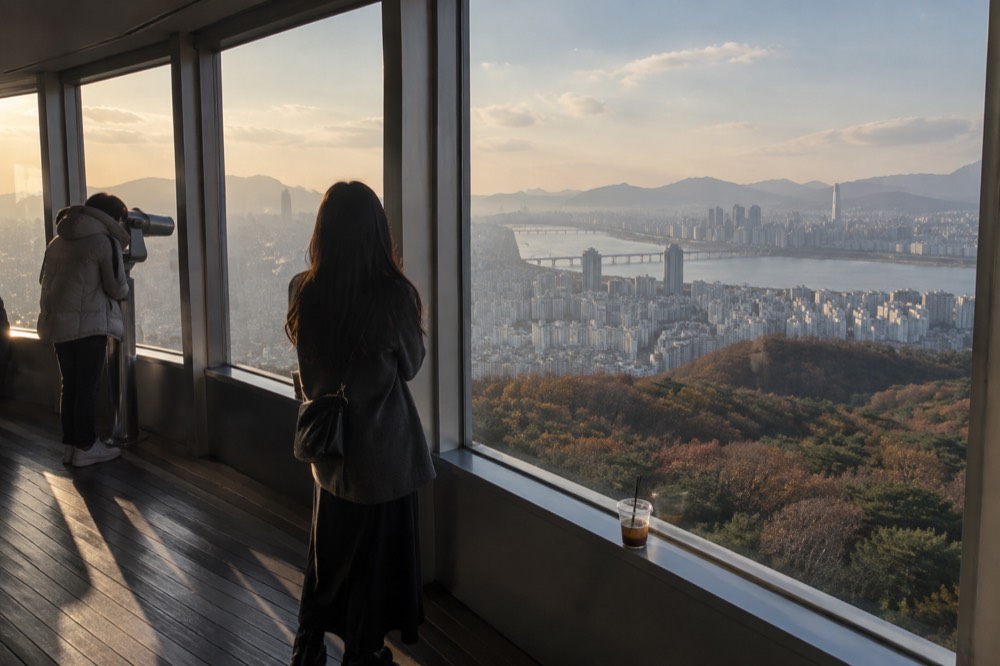
The next turning point was corporate and cosmetic at once. YTN acquired the tower in April 2000, a renovation contract with CJ followed in 2005, and after a full renovation running April to November of that year the building was renamed "N Seoul Tower" in December 2005. The new name, the renewed floors and the renewed restaurants gave the tower the modern identity it still carries. Later milestones kept arriving from official bodies: a Korea Tourism Star from the Ministry of Culture, Sports and Tourism in December 2015, a vote by Korean and foreign tourists naming it the number one Hallyu attraction in Seoul in September 2016, and designation as a Seoul Future Heritage in December 2018.
| Year | Event |
|---|---|
| October 1971 | Steel mast completed |
| April 1972 | MBC-TV transmission begins from the site |
| July 1975 | Observatory floors completed |
| October 1980 | Observatory opens to the public |
| February 1989 | Joins the World Federation of Great Towers |
| April 2000 | YTN acquires the tower |
| December 2005 | Renamed "N Seoul Tower" after full renovation |
| January 2011 | Tower body lighting begins signalling fine-dust levels |
| December 2018 | Designated a Seoul Future Heritage |
The deck itself is the part most visitors pay for, and the standard way in is the observatory ticket, which covers the observation levels inside the tower. It is worth being precise about what the ticket buys, because the mountain around the tower is free and only the deck inside is ticketed. The operator's fee page puts the adult gate price at KRW 29,000, and the online listing for the same product starts from US$15.25 per adult, rated 4.6 across 34,365 reviews.
The dramas and films that made it a Hallyu landmark
The tower's international fame tracks the Korean Wave directly: dramas used the tower and its mountain as a recurring romantic setting, the city's tourism bodies promoted those locations, and in 2025 Netflix's own locations guide confirmed that KPop Demon Hunters staged its climax on the hill of Namsan Tower, putting the real structure in front of a global audience.
The pattern began with television. The stone steps up Namsan's southern slope are still called the Sam-soon Steps, after the drama "My Lovely Sam-soon", and the tower operator itself attaches that drama to the steps in its own materials. That is the earliest on-screen association on file with a second source behind it, and it set a template: a couple, a mountain, a tower, a view. Once a landmark appears in enough romantic scenes, audiences abroad start treating it as the visual shorthand for the city itself.
The film era took this much further. KPop Demon Hunters, released on Netflix on 20 June 2025, staged its climax at a fictional concert venue on Namsan: the demon ruler Gwi-Ma draws a crowd to a stadium set underneath N Seoul Tower, where the Saja Boys perform. Writer-director Chris Appelhans is quoted on Netflix's own locations guide saying: "The Saja Boys concert is staged on the hill of Namsan Tower, a beacon at the heart of the city, summoning everybody." Netflix's page also notes the real tower is a working broadcast and communications tower, which is why the story uses it as a transmitter of something else. The film's own logic, in other words, is built on the tower's original purpose.
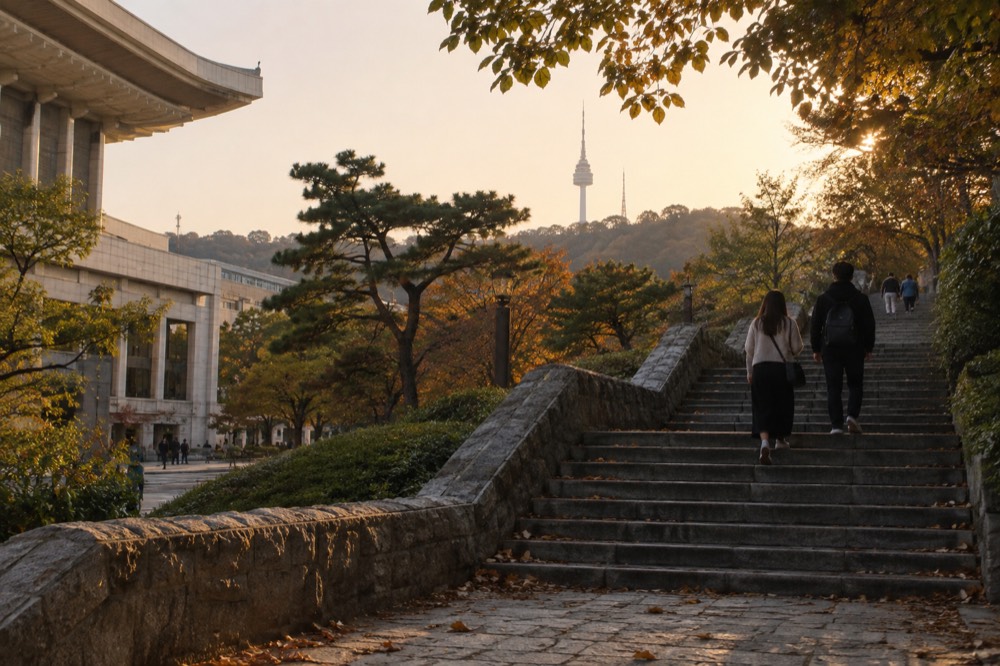
The real-world effect was noticed at the highest level of city government. Visiting Namsan in October 2025 to inspect access improvements, Mayor Oh Se-hoon said of the mountain: "With its recent appearance in K-Pop Demon Hunters, even more domestic and international tourists are expected to visit." The Korea Times ran a feature retracing the film's Seoul locations with the tower as its first stop, and the Korea Tourism Organization promoted the film's real locations through its own channels. When a mayor, a national tourism body and a wire feature all respond to a film by pointing at one mountain, the fame is no longer accidental.
For visitors who arrive because of the film or a drama and want the full experience, the fast-track observatory option is the premium version of the standard ticket. One honest note on it: it skips the ticket counter, and a buyer reported no visible fast-track lane beyond that, so treat it as a convenience option rather than a guaranteed queue jump, since riders still queue for the cable car.
The love locks and the free summit beneath the tower
A large part of the tower's fame costs nothing: Namsan Park, the summit plaza, the terraces around the tower base, the Palgakjeong pavilion area, the love locks, the beacon mound and the Seoul City Wall path are all free, and only the observation deck inside the tower needs a ticket. The padlock ritual, which the city itself promotes, is the most famous free thing on the mountain.
The love locks are the participatory layer of the tower's fame. Couples buy a padlock, often engraved on the spot, attach it to the railings on the summit, and throw away the key. What matters for this story is the ritual's official standing: Seoul's own city government lists the Locks of Love among Namsan's attractions, alongside the heart chairs and the sticker photo booths, and the cable car company lists the locks as one of its three attraction cards. The city's brand-new guided night walk over the summit routes walkers past the love lock deck by name, between N Seoul Tower and Palgakjeong, which settles that the locks are neither removed nor off limits.
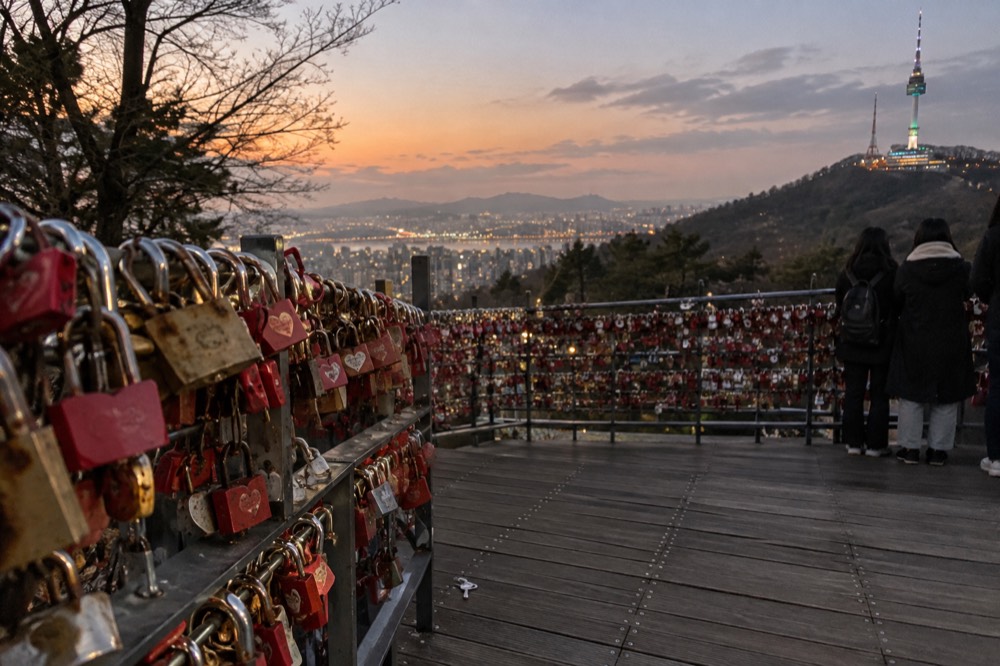
Visitors report buying locks on site, including branded locks with engraving done there, though nothing about where they are sold or what they cost is verified, so this page will not guess. The question people actually ask is whether the locks get cleared out. The honest answer from the research on file: no removal programme has been announced by the tower operator, the city or the cable car company, and no source says the locks are cleared on a cycle. Neither is there a source saying they are never touched. That is the full verified position, in words.
The free-versus-paid boundary is the single most useful thing to understand about the mountain, and it is the reason the tower's fame extends far beyond ticket buyers. Seoul's official tourism site states it plainly: the entrance to Namsan Park is free. The observatory entrance sits at Plaza 5F, with a second ticket booth at Tower 1F, and everything below and outside that gate, including the whole retail plaza with its Starbucks, convenience store and food counters, is open without a ticket. The operator's own FAQ confirms that The Place Dining on Tower 2F can be used without buying an observatory ticket, and directs visitors bringing their own food to the open plaza in front of Palgakjeong.
| Free, no ticket needed | Paid |
|---|---|
| Namsan Park and its trails | The observation deck ticket |
| The summit plaza and terraces around the tower base | The cable car, if you ride it |
| The love locks and the Palgakjeong pavilion area | The Namsan circular bus fare |
| The beacon mound and the Seoul City Wall path | Parking, food and shopping |
| The Seoul Tower Plaza shops and cafes | The Namsan Ormi inclined elevator is free |
The mountain has also become easier to reach, which quietly feeds the fame. The city opened the Namsan Sky Forest Trail, a barrier-free timber deck path, on 25 October 2025, built so wheelchair users and older visitors can get up Namsan, and it closed and ecologically restored the unofficial side paths that had been worn into the hillside. From September 2026, a free city-run guided night walk crosses the summit itself, with two evening departures, passing the tower and the love locks and finishing at Palgakjeong, as Seoul's own media hub announced. A mountain that is free, walkable and now guided at night keeps generating the foot traffic that fame needs to survive.
The tower that lights up with the city's air
Since January 2011, the tower body's lighting has signalled Seoul's fine-dust level, making the landmark a live indicator of the city's air quality, and the tower is also used for one-off commemorative light-ups requested by outside bodies, including a diplomatic anniversary lighting staged by the Korean and Japanese foreign ministries.
This is the layer of fame that no photograph fully captures. Most landmark towers are lit decoratively; this one is lit informatively. The operator's own timeline dates the start of the fine-dust signalling to January 2011, and YTN Seoul Tower, which owns the tower building, states that the city of Seoul and the tower use the lighting to indicate the air-pollution level. The specific colour code behind the signalling is not verified anywhere on file, so this page will not invent one, but the fact of the signalling is solid and it changes how the tower reads to locals: it is a building that tells you something about the day you are having.
The lighting also serves diplomacy and remembrance. A documented example: the Korean and Japanese foreign ministries staged a commemorative lighting at the tower for the sixtieth anniversary of their diplomatic relations. That pattern, one-off light-ups requested by outside bodies, sits alongside the daily air-quality signalling and gives the tower a role as the city's notice board.
One honest gap worth knowing: nobody official publishes a switch-on time for the tower's exterior lighting. No operator, tower or Seoul city page publishes a schedule for when the lights come on or go off, so the tower's lighting can change without notice. The switch-on times that circulate in third-party guides repeat each other without a primary source. What is fixed and official is the observatory's own clock: 10:00 to 22:30 on weekdays, 10:00 to 23:00 on weekends and public holidays, with last admission 30 minutes before closing, open 365 days a year.
Why the fame keeps renewing itself
The tower stays famous because each generation adds its own layer without erasing the last: the broadcast mast, the 1980 observatory, the 2005 renovation and renaming, the dramas, the locks, the air-quality lighting and now a Netflix film and a free city night walk, all stacked on one free mountain in the centre of Seoul.
There is a structural reason this keeps working. The tower sits at the intersection of three free things, the park, the summit and the view, and one paid thing, the deck. That means the landmark is experienced by far more people than ever buy a ticket, and every one of those visits is a potential photograph, padlock or memory that renews the fame at no cost to the visitor. A landmark that charges nothing for its best angle never runs out of ambassadors.
The city government behaves as though it knows this. Its April feature on Namsan groups the trail, the Locks of Love, the heart chairs, the photo booths and the Palgakjeong night view together and prices only the observatory, and its trail programme keeps adding ways up the mountain, from the barrier-free Sky Forest Trail to the new night walk. The city's own Namsan feature is the clearest statement of how Seoul itself frames the mountain: a free public park with one paid viewpoint at the top.
The broadcast function never went away either, and that is part of the charm. The tower still transmits, which is precisely why a 2025 animated film about demons and idols could build its climax around the idea of the tower transmitting something. A structure that began as infrastructure and remained infrastructure, while accumulating a restaurant that rotates once every 1 hour 40 minutes, a post office that sends postcards worldwide, digital telescopes with 36x zoom and a wall of padlocks, is doing several jobs at once. Fame of that kind is durable.
For most visitors the decision is simple: walk up or ride up for free, decide at the base whether the deck view is worth the ticket, and let the mountain do the rest. If you want to read more before deciding, our guide to N Seoul Tower ticket options explained covers every way in, and our piece on whether N Seoul Tower is worth visiting weighs the deck against the free summit. This site, Namsan Tower Seoul, keeps the whole free-versus-paid picture current.
The classic ticket remains the straightforward choice for the famous view: the observatory ticket, from US$15.25 per adult, rated 4.6 across 34,365 reviews, covering the observation levels inside the tower.
However you do it, the three options below cover the ways most visitors experience the landmark:
Common questions about Seoul Tower's fame
Why Is Seoul Tower So Famous?
Seoul Tower is famous because it stands on the central mountain of Seoul, visible from most of the city, and because layers of fame accumulated on it: a public observatory opened in October 1980, decades of drama and film appearances, the love-lock ritual, air-quality signalling lighting since January 2011, and a globally watched 2025 Netflix film that staged its climax on the hill below the tower.
Was Seoul Tower built to be a tourist attraction?
No. It was built as a television and radio transmission mast, with the steel mast completed in October 1971 and TV transmission beginning in 1972. The observatory floors were completed in July 1975, but the public opening only came in October 1980, turning infrastructure into a destination.
Is it free to visit Seoul Tower?
The mountain is free; the deck is not. Namsan Park, the summit plaza, the terraces around the tower base, the love locks, the beacon mound, the Seoul City Wall path, the plaza shops and cafes, the Namsan Ormi inclined elevator and the cable car company's Myeongdong shuttle bus all cost nothing. Only the observation deck inside the tower needs a ticket.
What film made Seoul Tower famous again recently?
KPop Demon Hunters, released on Netflix on 20 June 2025, staged its climax at a fictional stadium set underneath N Seoul Tower. Netflix's own locations guide confirms the setting, and Seoul's mayor publicly linked the mountain's visitor surge to the film.
Why is it called N Seoul Tower now?
The tower was renamed "N Seoul Tower" in December 2005 after a full renovation running April to November of that year, under a renovation contract between YTN, which had acquired the tower in April 2000, and CJ. Many people still call it Seoul Tower or Namsan Tower.
Does the tower's lighting mean something?
Yes. Since January 2011 the tower body's lighting has signalled Seoul's fine-dust level, and the tower is also used for one-off commemorative light-ups, such as a diplomatic anniversary lighting staged by the Korean and Japanese foreign ministries. The specific colour code is not published in any verified source.